
Why Continuous Compliance Monitoring Matters More Than Ever
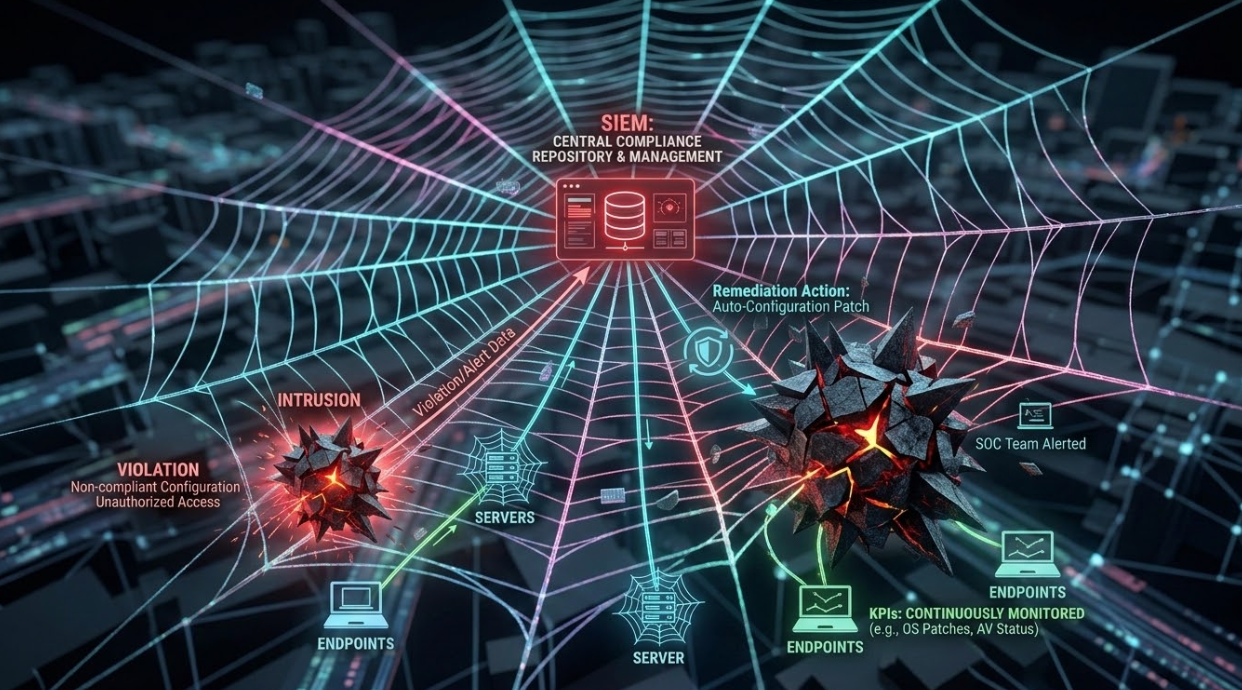
Continuous compliance monitoring provides the ongoing visibility organizations need as AI-accelerated attacks shorten the time between vulnerability discovery and exploitation. Atomicorp’s Atomic OSSEC EDR delivers continuous compliance monitoring and benchmarking across IT and OT environments through agent-based or agentless deployment on modern, legacy, and unsupported operating systems. Built-in antivirus, endpoint firewall, file integrity monitoring, vulnerability scanning, and automated response extend compliance into active protection.
Check out Atomic OSSEC for continuous compliance monitoring.
State of Things: Periodic Compliance Is No Longer Enough
For years, compliance was largely a point-in-time exercise. Organizations prepared for an annual assessment, generated reports, fixed deficiencies, and repeated the process the following year. That approach made sense when cyber threats evolved relatively slowly.
Today’s threat landscape is very different. Attackers continuously scan for exposed systems, newly disclosed vulnerabilities, and configuration mistakes. AI is making many of these activities faster, more automated, and more scalable. A server that was compliant yesterday can become vulnerable overnight because of a newly discovered CVE, an unauthorized configuration change, or an unexpected software update.
AI is making cyber attacks faster, more automated, and more scalable. Security compliance frameworks are responding accordingly.
Compliance frameworks have evolved accordingly. Rather than focusing solely on periodic assessments, many now emphasize continuous control monitoring (CCM), ongoing evidence collection, and the ability to demonstrate that security controls remain effective between audits.
Frameworks including NIST SP 800-53, NIST SP 800-171 Rev. 3, PCI DSS v4.0, CMMC 2.0, ISO/IEC 27001, CIS Controls, NERC CIP, and IEC 62443 all encourage or require continuous monitoring of systems, vulnerabilities, configurations, audit logs, and security events.
In other words, organizations are increasingly expected to prove—not simply assume—that their controls continue working every day.
Visit the Atomicorp server and cloud compliance page.
How Atomicorp Delivers Continuous Compliance Monitoring
Atomic OSSEC continuously monitors endpoints, servers, cloud workloads, and operational technology (OT) assets for the changes that matter most to security teams, plant managers, and auditors.
Atomicorp real-time file integrity monitoring detects unauthorized changes to operating system files, application files, and critical configurations. Rather than simply alerting that something changed, Atomic OSSEC helps answer the questions auditors and incident responders immediately ask:
- Who made the change?
- What changed?
- When did it occur?
- Where did it occur?
- Was the change authorized?
At the same time, continuous configuration monitoring detects configuration drift from approved baselines, while the built-in compliance scanner compares systems against security policies, CIS Benchmarks, and other organizational requirements.
Continuous vulnerability scanning and CVE correlation identify newly discovered software vulnerabilities across large endpoint populations, allowing organizations to prioritize remediation before vulnerabilities become compliance findings or successful attacks.
Atomic OSSEC also automates audit evidence collection through detailed logging, reporting, and audit controls that simplify demonstrating compliance during assessments.
Beyond Monitoring: Preventing and Responding to Threats
Continuous compliance monitoring is most valuable when it becomes part of a broader defense-in-depth strategy. Unlike compliance-only tools that only identify deficiencies, Atomic OSSEC combines continuous monitoring with full endpoint detection and response capabilities.
Built-in antivirus and antimalware provide the first layer of endpoint protection. Endpoint firewall policies help reduce attack surfaces and limit lateral movement. Intrusion detection continuously analyzes activity for suspicious behavior, while automated active response can rapidly isolate compromised systems, block malicious activity, and reduce the impact of an attack before it spreads.
This layered approach allows organizations to move beyond simply knowing they have experienced a security event. They can detect, investigate, contain, and respond to threats while simultaneously collecting the audit evidence required for ongoing compliance.
For organizations responsible for protecting CUI, critical infrastructure, healthcare data, payment card information, or sensitive intellectual property, compliance monitoring alone is not enough. Atomic OSSEC combines continuous compliance monitoring with layered endpoint protection, helping organizations both demonstrate that security controls are operating as intended and defend the systems those controls are designed to protect.
Efficient Continuous Compliance Across Hybrid Environments
Modern enterprises rarely operate a single operating system or deployment model. Compliance monitoring must span Windows, Linux, Unix, cloud platforms, containers, legacy systems, and operational technology without dramatically increasing administrative overhead.
Atomic OSSEC supports both agent-based and agentless deployment, enabling continuous compliance monitoring across modern, legacy, and unsupported operating systems, including servers, cloud workloads, OT environments, and aging infrastructure.
Its multi-agent vulnerability scanner quickly assesses thousands of endpoints, while centralized GUI management simplifies policy deployment, compliance review, investigation, and endpoint administration from a single console. Organizations with strict data sovereignty requirements, such as for GDPR, can also keep security monitoring and data entirely within their own environments.
Atomic OSSEC provides the foundation for continuous compliance monitoring, benchmarking, and audit readiness. For Internet-facing applications, Atomic WAF and Atomic ModSecurity Rules extend protection with virtual patching, web application firewall capabilities, and continuously updated attack detection. Together these products deliver stronger defense in depth, while Atomic OSSEC remains the primary platform for continuous compliance monitoring, compliance benchmarking, and audit readiness.
Continuous Compliance Is Becoming Continuous Security
The line separating cybersecurity and compliance continues to blur.
Organizations are increasingly expected to demonstrate that security controls remain effective over time—not simply at audit time. Continuous compliance monitoring provides the ongoing visibility needed to verify security posture, detect drift, and produce audit evidence as systems and threats evolve.
Atomic OSSEC helps organizations achieve continuous compliance across modern, legacy, cloud, and OT environments while strengthening overall security through real-time monitoring and layered endpoint protection. As compliance programs continue shifting toward continuous assurance, organizations with continuous visibility will be better prepared for both auditors and attackers.
Continuous Compliance Monitoring Q&A
Q1: What is continuous compliance monitoring?
Continuous compliance monitoring is the ongoing assessment of systems, devices, and security controls to determine whether an organization continues to meet internal policies and external compliance requirements. By continuously scanning and analyzing IT and OT environments, organizations gain real-time visibility into their compliance posture, identify configuration drift and control gaps, and detect vulnerabilities before they become audit findings or security risks.
Rather than relying on periodic manual assessments, continuous compliance monitoring automates evidence collection, tracks changes as they occur, and provides up-to-date reporting for frameworks such as NIST SP 800-53, NIST SP 800-171, PCI DSS, CIS Benchmarks, CMMC, and many others. The result is a more accurate picture of ongoing compliance while reducing the effort required to prepare for audits.
Q2: What compliance frameworks require continuous monitoring?
Many of today’s leading cybersecurity and regulatory frameworks either explicitly require or strongly encourage continuous monitoring to ensure security controls remain effective between formal audits. Rather than relying solely on annual or point-in-time assessments, organizations are expected to continuously detect configuration changes, monitor vulnerabilities, collect audit evidence, and respond to security events as they occur.
Sample frameworks that incorporate continuous monitoring include:
- NIST SP 800-53 – Continuous Monitoring (CA-7), audit logging, configuration management, file integrity, and vulnerability management.
- NIST SP 800-171 – Ongoing monitoring of systems handling Controlled Unclassified Information (CUI), including audit events, configuration changes, and vulnerability management.
- PCI DSS v4.0 – Continuous security monitoring, file integrity monitoring, vulnerability scanning, logging, and regular validation of security controls.
- CMMC 2.0 – Built upon NIST SP 800-171, emphasizing continuous protection of CUI and ongoing evidence that security controls remain effective.
- CIS Controls – Continuous monitoring of assets, configurations, vulnerabilities, and security events to maintain a secure environment.
- ISO/IEC 27001 – Ongoing monitoring, measurement, internal auditing, and continual improvement of the information security management system (ISMS).
- NERC CIP and IEC 62443 – Ongoing monitoring and security management of industrial control systems (ICSs) and operational technology (OT) environments to maintain security and operational integrity.
Organizations adopting continuous compliance monitoring are often able to reduce audit preparation time, identify compliance gaps sooner, and maintain a more accurate view of their security and compliance posture throughout the year.
Q3: What is continuous monitoring in NIST SP 800-171 and how can Atomicorp help?
NIST SP 800-171 calls for organizations to continuously monitor systems that store, process, or transmit Controlled Unclassified Information (CUI) to ensure security controls remain effective over time. This includes collecting and analyzing audit logs, detecting unauthorized changes, monitoring vulnerabilities, validating security baselines, and maintaining evidence that supports ongoing compliance.
Atomicorp’s Atomic OSSEC EDR helps automate this process by continuously monitoring endpoints and servers, collecting and analyzing security events, detecting configuration drift and file integrity changes, correlating vulnerabilities, validating compliance against required baselines and benchmarks, and generating real-time alerts and audit-ready reports. By supporting both agent-based and agentless deployments across modern, legacy, and unsupported operating systems, Atomic OSSEC helps organizations maintain continuous visibility into their compliance posture while reducing the effort required to prepare for NIST SP 800-171 assessments.