
How AI Increases the Security Risks of End-of-Life Software, and What You Can Do About It
End-of-life software with unpatched vulnerabilities offer low-hanging fruit for AI-assisted cyberattacks. Orchestrating defense in depth around unsupported systems can reduce the attack surface, strengthen detection and response, limit the blast radius, and buy defenders more time.
Cybersecurity may be approaching a point where attacks move substantially faster than defenders can deflect and contain. Artificial intelligence is not replacing human cyberattackers, but it is increasingly giving them tools to accelerate reconnaissance, vulnerability research, exploit development, malware creation, and other stages of an attack.
That creates a serious concern for organizations operating legacy and end-of-life (EOL) software. Unsupported systems may continue to perform essential business, industrial, or customer-facing functions while no longer receiving vendor security updates. As AI reduces the time and expertise required to find and exploit weaknesses, the risk surrounding those systems grows.
Atomicorp helps organizations address this problem with affordable defense-in-depth security for legacy IT, cloud workloads, web applications, and operational technology (OT) environments. Atomic OSSEC provides endpoint detection, server hardening, monitoring, and response capabilities around systems that may be difficult to patch or replace. Atomic WAF and Atomic ModSecurity Rules add web application protection and virtual patching for Internet-facing applications and APIs.
The goal is not to pretend an EOL system is fully modern or risk-free. It is to reduce its exposure, make exploitation more difficult, detect suspicious activity sooner, and contain an attack before it reaches critical assets.
Why AI Raises the Risk for End-of-Life Software
Legacy software does not suddenly become vulnerable because artificial intelligence exists. Likewise, software does not necessarily become insecure on the day vendor support ends.
The problem is what happens afterward.
Once a product reaches end of life or otherwise loses vendor support, security patches may stop. Newly discovered EOL software vulnerabilities can remain unpatched unless an organization has another remediation option or a compensating control in place. Over time, the organization is left running software in an evolving threat environment while the software itself remains largely frozen.
CISA, the U.S. government’s lead civilian cybersecurity agency, has long identified unsupported operating systems as a significant source of vulnerability exposure, particularly because many legacy systems perform mission-critical functions and cannot easily be replaced.
AI adds a difficult new variable: it can help researchers and attackers investigate software for weaknesses more quickly and at greater scale.
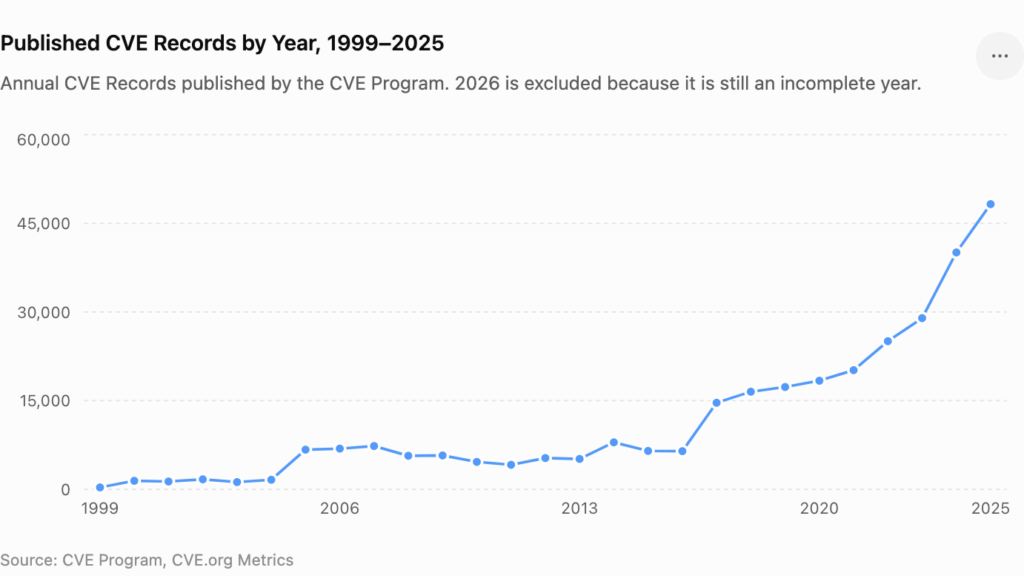
Meanwhile, the number of published Common Vulnerabilities and Exposures (CVE) Records has risen sharply since 2017, reaching record levels in recent years. AI may accelerate vulnerability discovery further, but its greater near-term impact could be in reopening old wounds—helping attackers identify, analyze, and exploit known vulnerabilities in legacy and unsupported systems faster. (See Figure 1.)
Figure 1
Beyond that, a forecast for the remainder of 2026 is in order, with the number of CVEs growing at an estimated conservative 36.8 percent (year to year), with some studies placing the increase as high as 46 percent. (See Figure 2.)
Figure 2
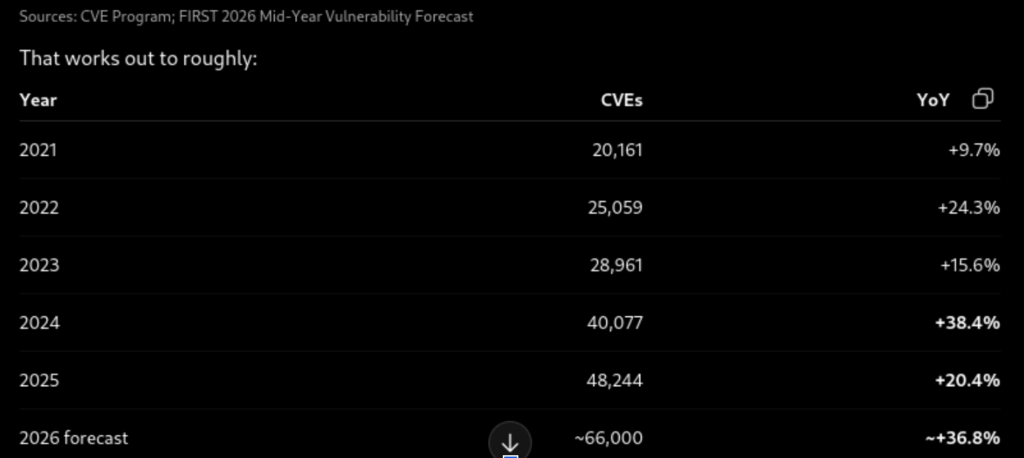
Source: CVE Program, CVE.org — Published CVE Records
AI systems can assist with code analysis, vulnerability discovery, exploit development, and automation of portions of the vulnerability research process. Security research has shown that advanced models can identify previously unknown vulnerabilities and develop exploit components. Anthropic, for example, reported that it and its Project Glasswing partners used Claude Mythos Preview to identify more than 10,000 high- or critical-severity vulnerabilities.
For supported software, vulnerability discovery typically starts a familiar race: defenders work to patch while attackers attempt exploitation.
For unsupported software, there may be no vendor patch coming at all.
AI Compresses the Attack Chain
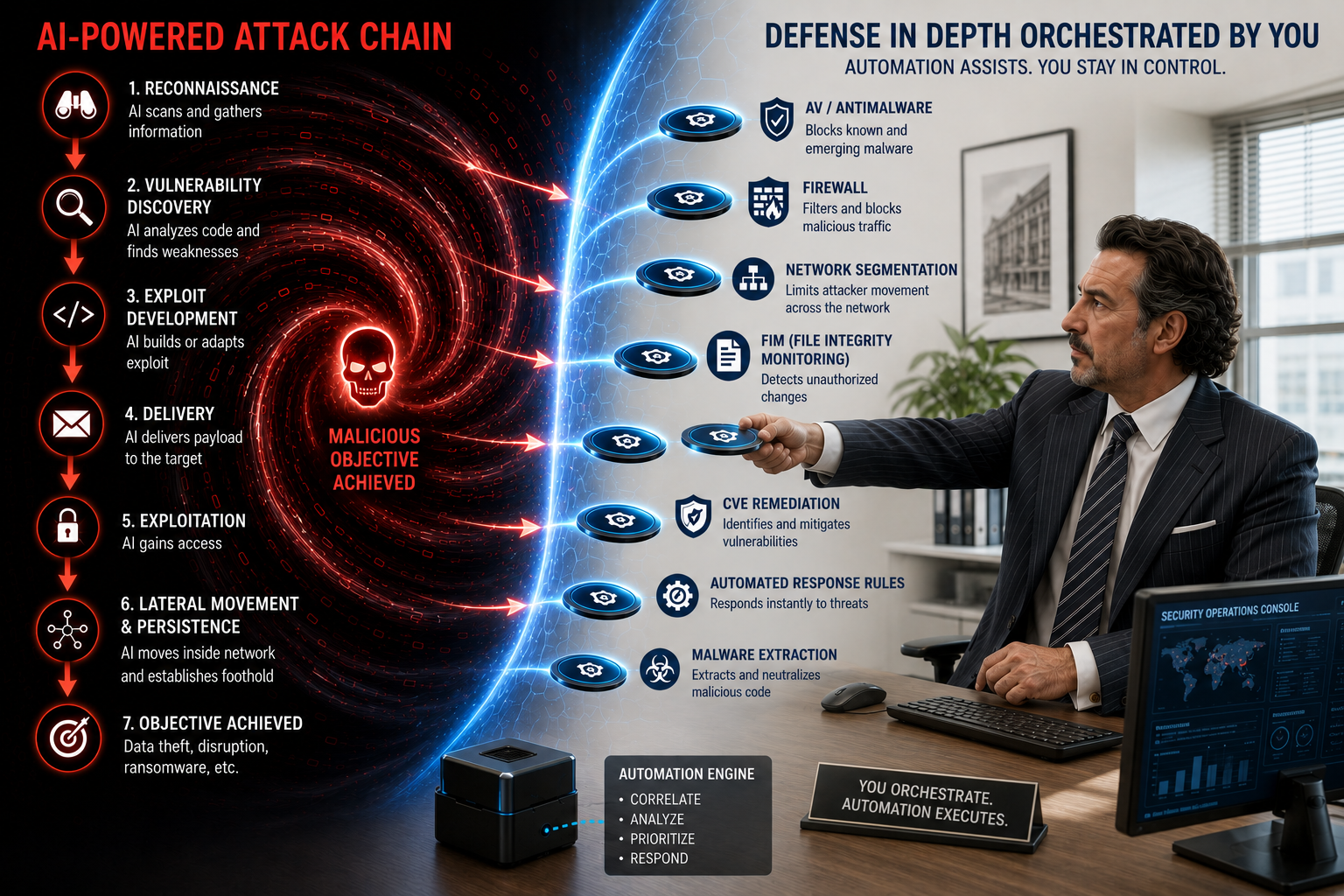
AI is beginning to compress the attack chain: identifying vulnerable software, analyzing a weakness, developing or adapting an exploit, and using it against a target.
Historically, several of those activities required extensive manual research, specialized knowledge, and time. Increasingly capable AI models can assist with many of them.
Researchers have demonstrated models turning vulnerabilities into exploit components and combining them into attack chains in controlled environments. Google Threat Intelligence Group has also reported that threat actors are using AI across the attack lifecycle, including for vulnerability research and exploit development.
This does not mean every attacker can press a button and launch a fully autonomous attack against a real-world organization. Public evidence of completely autonomous, end-to-end attacks remains limited.
Attackers do not need complete autonomy for AI to materially change the risk equation. If AI makes reconnaissance, vulnerability analysis, exploit development, phishing content, or malware iteration faster, defenders have less time to act. Google Cloud reported that the interval between vulnerability disclosure and active exploitation had already fallen from weeks to days during the second half of 2025.
For legacy system vulnerabilities that cannot be readily patched, that compressed timeline can be particularly dangerous.
Build Layers Around Vulnerable Systems
When immediate replacement or patching is not realistic, organizations need controls that protect the system from multiple directions. Defense in depth should reduce attack surface, detect malicious behavior quickly, limit lateral movement, and support containment when prevention fails.
Atomic OSSEC can provide an important multilayer defense solution for legacy and EOL systems. Its capabilities can help organizations harden and monitor servers, workloads, and endpoints while improving visibility into changes that may signal compromise.
Key protective capabilities include:
- Host-based firewalls that control traffic entering and leaving individual systems
- Antivirus and antimalware protection
- Intrusion detection
- Real-time file integrity and change monitoring
- CVE detection and vulnerability management
- Configuration and compliance assessment
- Data loss prevention
- Application allowlisting and blocklisting
- Centralized logging and SIEM visibility
- Automated and active response
- Network and workload segmentation support
- Deception technologies and honeypots
These controls do not remove the underlying vulnerability from unsupported software security exposures. They can, however, make a successful compromise more difficult, reduce attacker dwell time, and create more opportunities to detect and respond before an incident expands.
Server hardening is a foundational step. Organizations can disable unnecessary services, close unused ports, remove unneeded software, restrict permissions, enforce least privilege, strengthen authentication, and limit remote administrative access. For systems without vendor patches, those measures become even more important.
Reduce the Blast Radius
Organizations should assume that some attacks will eventually bypass a preventive control. The question is whether an initial foothold provides access to the rest of the environment.
Network and workload segmentation, least privilege, host-based firewalling, application controls, restricted remote access, and isolation of high-value resources can make lateral movement more difficult. Air gaps may also be appropriate for certain critical operational or sensitive environments. These measures reduce the blast radius of a successful compromise by limiting the systems, applications, identities, and data accessible from a single entry point.
Internet-facing applications need another layer of protection. A web application firewall can help detect and block malicious requests targeting known and emerging application-layer attacks. Atomic WAF and Atomic ModSecurity Rules provide Layer 7 protections for web applications and APIs.
Virtual patching is especially valuable when a software patch is unavailable, cannot be deployed immediately, or could disrupt a fragile legacy application. It can help block exploit attempts at the web layer while the organization evaluates a permanent remediation, isolates the affected asset, or plans a replacement.
When Attackers Get Faster, Defenders Need Time
AI does not create the underlying problem with legacy and end-of-life software. Unsupported systems have always carried elevated risk when vulnerabilities cannot be addressed through normal vendor patching. What AI changes is speed, scale, and accessibility.
As AI vulnerability discovery and AI vulnerability exploitation capabilities improve, relying on obscurity or assuming attackers will not spend time researching aging software becomes increasingly risky. Organizations should identify their unsupported assets, assess exposure, harden systems, monitor continuously, segment critical resources, and deploy compensating controls where remediation is not possible.
Atomicorp helps make this practical by combining endpoint and workload protection through Atomic OSSEC with web application protection and virtual patching through Atomic WAF and Atomic ModSecurity Rules.
Organizations may not be able to eliminate every vulnerability in a legacy system. They can surround it with preventive, detective, and responsive controls that make exploitation harder and containment faster.
In an era of AI-powered cyberattacks, defense in depth does more than reduce risk. It buys defenders time.