
What Is Security Information and Event Management?
Security information and event management (SIEM) brings security events, logs, and telemetry together to detect threats, investigate activity, monitor compliance, and support response. Atomic OSSEC combines SIEM with endpoint detection and response (EDR), providing security monitoring and analysis across modern and legacy systems.
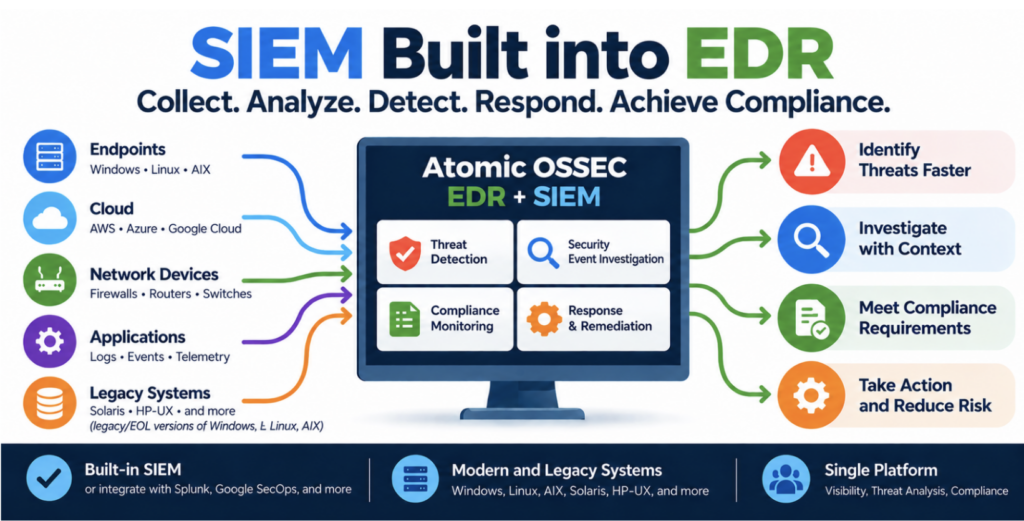
Instead of examining individual logs and systems separately, security teams can use SIEM to centralize information for analysis and security event investigation. It can help answer important questions: What happened? Where? How severe is it? Which systems are affected? Does the activity indicate an attack, vulnerability, configuration problem, or compliance issue?
A SIEM can also prioritize security events, generate alerts, retain information for investigations and audits, and provide dashboards and reports for security and compliance teams.
Why Is SIEM Crucial to Security and Compliance?
Modern organizations generate enormous amounts of security data. The challenge is identifying significant events quickly enough to detect and respond to security threats.
SIEM provides a centralized view across systems that might otherwise be monitored separately. Event correlation can reveal suspicious activity that is difficult to recognize from individual logs, while historical information helps analysts investigate incidents and affected systems.
SIEM compliance monitoring can also document security activity, identify potential control violations, and support compliance reporting and audits. File changes, user activity, vulnerabilities, configuration issues, alerts, and response actions can provide evidence that required security controls are operating as expected.
Atomic OSSEC SIEM: From Endpoint Data to Action
A SIEM is only as useful as the information it receives. Atomic OSSEC analyzes logs and security telemetry and adds endpoint context to help organizations understand what is happening and where.
Security teams can use Atomic OSSEC to:
- Prioritize security information. Organize events by severity and other characteristics so analysts can focus on relevant activity.
- Investigate security events. Search endpoint activity, vulnerabilities, file changes, security events, and other information from a centralized interface.
- Monitor compliance. Review security and compliance information and generate reports for assessments and audits.
- Detect and respond. Connect SIEM information with intrusion detection, file integrity monitoring (FIM), vulnerability detection, endpoint protection, active response, and security automation.
- Integrate security information. Use the built-in SIEM or route security data and alerts to other SIEM and security operations platforms.
This turns security information into context for investigation, prioritization, compliance, and response rather than a stream of isolated alerts.
SIEM for Modern and Legacy Endpoint Security
Security monitoring becomes more difficult when organizations operate a mixture of current and legacy and end-of-life systems. Older platforms may still support critical applications and workloads even when newer security products no longer support them.
Atomic OSSEC provides SIEM for endpoint security across Windows, Linux, AIX, Solaris, HP-UX, macOS, cloud workloads, and other supported systems. Its log-based intrusion detection and endpoint monitoring bring security information from modern and legacy systems into a common security environment.
Organizations can use the SIEM built into Atomic OSSEC or integrate security information with an existing SIEM, adding endpoint visibility without abandoning their established security operations architecture.
Get SIEM, EDR, threat detection, response, and compliance capabilities in one security platform.
SIEM FAQ
Request Your 30 Minute Demo
See why thousands of organizations trust Atomicorp for threat detection, attack protection, and compliance.


Meet 99 Specific PCI Requirements with a Single Solution for On-premise, Cloud, or Hybrid Environments

Free Guide: The 3 Most Critical Capabilities for Securing Cloud Workloads
Download this free guide to see the most important steps to achieving security and compliance for workloads running in the cloud.