
HPC Security Beyond OS Hardening: Protecting Enterprise Linux and Advanced Computing Infrastructure
High-performance computing (HPC) and AI infrastructure providers deliver the operating systems, management tools, and expertise behind demanding workloads. Yet their OS hardening and patching alone cannot address every cyber threat. Continuous file integrity monitoring (FIM), intrusion detection, vulnerability management, and automated response extend security across enterprise Linux and heterogeneous computing environments. For customers, these capabilities protect critical workloads, sensitive data, intellectual property, and operational continuity.
Where Infrastructure Management Meets Threat Detection
Enterprise Linux and HPC infrastructure providers operate within a broad computing ecosystem that includes Oracle, NVIDIA, Amazon Web Services (AWS), Microsoft Azure, Google Cloud, and numerous specialized Linux, HPC, and AI infrastructure vendors. These companies deliver combinations of operating systems, computing platforms, hardware acceleration, cluster management, and cloud services that support scientific research, AI development, financial modeling, and other demanding workloads.
Their customers depend on reliable systems, efficient workload orchestration, and secure access to computing resources.
Security is already part of that foundation. Supported operating systems, timely patches, hardened configurations, and access controls reduce exposure to known threats.
However, building and maintaining secure infrastructure is not the same as continuously detecting threats against it. Infrastructure providers can extend their offerings with security monitoring that identifies unexpected changes, suspicious activity, and emerging vulnerabilities.
For end customers, these capabilities provide greater visibility into the security of the environments supporting their most important work.
Real-Time File Integrity Monitoring: Tracking Unexpected Change
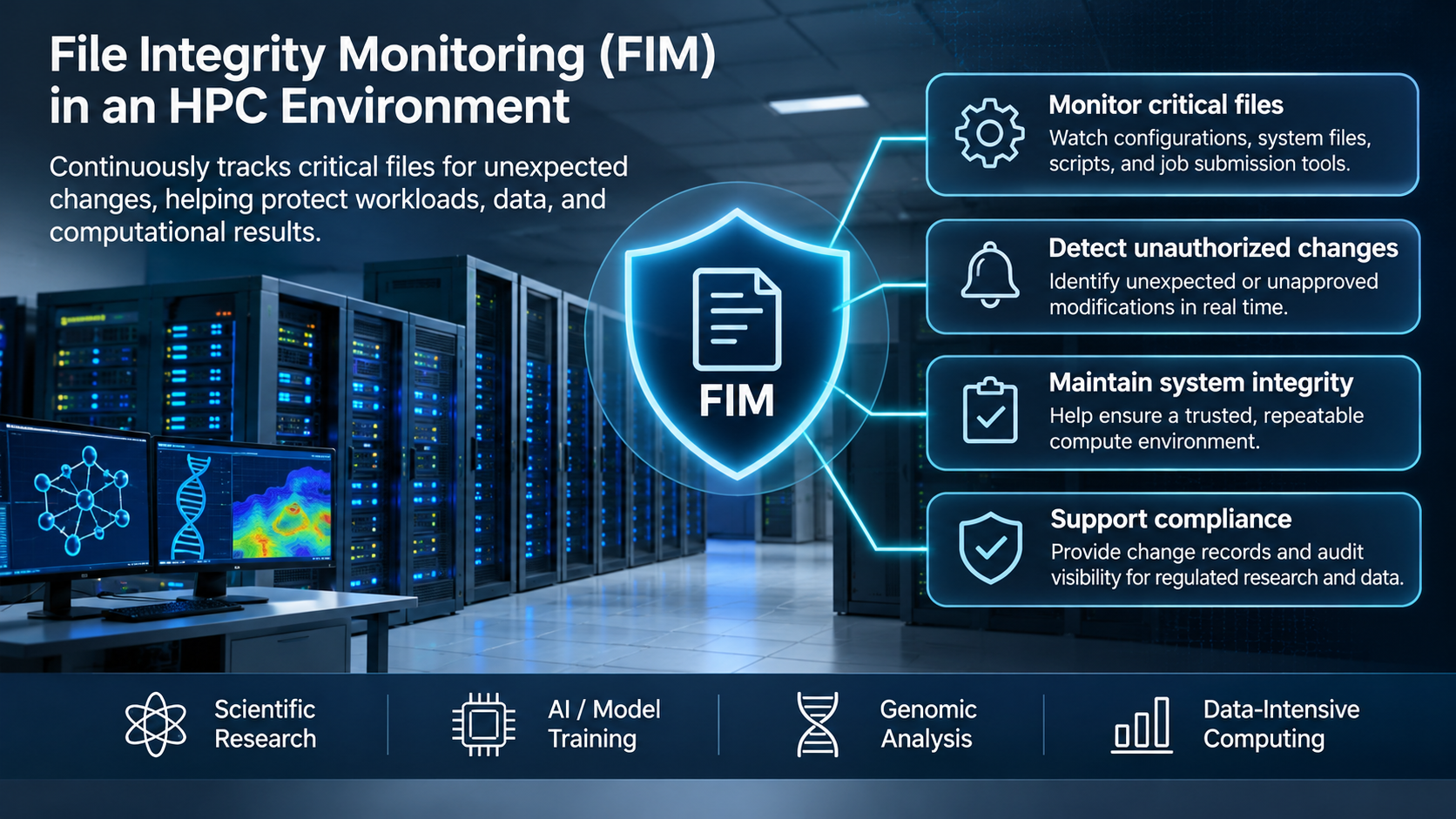
Real-time file integrity monitoring (FIM) provides a practical example of complementary security.
HPC environments depend on operating system binaries, configuration files, administrative scripts, job submission scripts, and application components. Unauthorized modifications can affect how workloads execute, how resources are accessed, and potentially the integrity of computational results.
FIM detects changes to monitored assets, allowing administrators to investigate suspicious activity and distinguish legitimate maintenance from potentially malicious modifications.
For infrastructure providers, FIM extends security monitoring beyond initial deployment and hardening. For customers, it provides greater confidence that critical computing processes and the files supporting them have not been altered without authorization.
Explore Atomicorp’s Linux and multiplatform security solutions featuring intrusion prevention, vulnerability detection, FIM and additional endpoint detection and response (EDR) and cloud workload protection capabilities.
Detecting Threats Beyond Known Vulnerabilities
Patching remains essential, but vulnerability remediation and intrusion detection address different risks. Even carefully maintained systems can experience credential compromise, malware, unauthorized activity, or attempted lateral movement.
Host intrusion detection, endpoint detection and response (EDR), and centralized security log analysis provide visibility into these threats. Vulnerability detection identifies affected software and supports remediation prioritization.
Atomic OSSEC brings together real-time FIM, host intrusion detection, vulnerability monitoring, security event analysis, and active response capabilities. These technologies complement infrastructure management by identifying threats and by supporting investigation and containment.
For customers, this means stronger protection for sensitive research data, proprietary models, intellectual property, and the availability of critical computing services.
Assess your CVE remediation effectiveness. Check out the new Atomicorp CVE research tool page.
Protecting the Interfaces Around the Cluster
HPC security extends beyond compute nodes. Research portals, administrative interfaces, APIs, and other web-based services can expose infrastructure to application-layer attacks.
Atomic WAF and Atomic ModSecurity Rules provide another protective layer by detecting and blocking malicious web requests, including SQL injection, cross-site scripting, and other application-layer exploits.
Meanwhile, the virtual patching in these solutions can also reduce exposure to certain vulnerabilities while applications await remediation.
For customers, protecting these interfaces reduces opportunities for attackers to compromise services, gain unauthorized access, or disrupt access to important computing resources.
Learn more about Atomic WAF and Atomic ModSecurity Rules.
Cross-Platform Security Beyond Enterprise Linux
Although Linux dominates HPC computing, the surrounding infrastructure may include Windows workstations, Unix systems, legacy operating systems, cloud services, and web applications deployed across on-premises and hybrid environments. These interconnected systems support administration, user access, data movement, and collaboration. A weakness in one component can create security risks elsewhere in the environment.
Cross-platform infrastructure security extends monitoring beyond the Linux cluster, providing more comprehensive visibility across supported systems.
Atomic OSSEC offers agent-based and agentless approaches for different operational requirements, including certain legacy and difficult-to-monitor systems. Coverage and available controls depend on the operating system, architecture, and deployment method.
Continuous Compliance and Security Accountability
Infrastructure providers may deliver hardened operating systems and compliance-ready configurations, but maintaining those configurations requires ongoing monitoring.
File changes, configuration drift, unauthorized activity, and newly discovered vulnerabilities can affect an organization’s security posture after deployment.
Continuous FIM, security logging, vulnerability monitoring, and audit reporting provide evidence that supports security assessments and compliance obligations. For regulated customers, these capabilities strengthen accountability and provide ongoing visibility into security controls rather than relying exclusively on periodic assessments.
Request a Demo.
Designing Security Around HPC Operations
HPC environments introduce operational considerations that conventional enterprise security deployments may not encounter. Compute nodes can be performance-sensitive, workloads may be short-lived, and legitimate file activity can generate substantial monitoring data. Security controls must be evaluated for compatibility, performance overhead, and operational impact.
Automated response introduces additional considerations. Blocking connections or isolating systems may interrupt important computational workloads. Providers should establish appropriate response policies, test them, and determine which actions require administrator approval.
The objective is to strengthen security without unnecessarily disrupting the computing operations customers depend on.
Advanced HPC Security Delivers Value Beyond the Infrastructure
For enterprise Linux and HPC providers, integrating continuous threat detection, vulnerability monitoring, compliance capabilities, and active response creates a more comprehensive security offering.
For the end customer, the value is measured by what those capabilities protect and preserve: sensitive research, intellectual property, computational integrity, operational continuity, and confidence in the infrastructure supporting critical work.
Researchers need confidence that their computational results have not been compromised. AI developers need to protect proprietary models and training environments. Financial institutions and government organizations require dependable computing services, security accountability, and evidence of compliance.
By combining infrastructure management with continuous cybersecurity monitoring and response, providers can deliver more than powerful computing environments. They can offer customers stronger security assurance throughout the infrastructure lifecycle.
Atomic OSSEC, Atomic WAF, and Atomic ModSecurity Rules extend that protection across supported hosts, applications, and computing environments.
Learn more about Atomicorp’s EDR and WAF security capabilities.
Contact Atomicorp to discuss security integration and deployment options for HPC environments.