
Are You Prepared for the Increase in AI-Accelerated Attacks? Roll Out Affordable Defense-in-Depth Security
Artificial intelligence is transforming cybersecurity, but not just for defenders. According to the Five Eyes intelligence alliance, the next generation of frontier AI models is dramatically accelerating cyberattacks by compressing the time between vulnerability discovery and exploitation from weeks into days—or even hours. For governments, critical infrastructure operators, and businesses alike, that means the cybersecurity landscape may change far sooner than many organizations are prepared for.
Rather than creating an entirely new category of cyberattack, advanced AI can make nearly every existing attack faster, more scalable, and more difficult to stop. Security leaders should view these developments not as distant possibilities but as emerging business risks that require stronger visibility, faster detection, and automated response capabilities.
Speak with us about how you can prepare.
Frontier AI Changes the Timeline: Prepare Now
The Five Eyes is an intelligence-sharing alliance of Australia, Canada, New Zealand, the United Kingdom, and the United States. In its June 23 warning, The Five Eyes described frontier AI as the leading generation of highly capable AI systems that approach or exceed human performance across many complex tasks, including software development, reasoning, planning, and cybersecurity research.
The alliance’s concern is straightforward: as AI becomes better at understanding software, writing code, and automating decision making, attackers can leverage those same capabilities to compress the traditional cyber kill chain.
Consider a newly discovered software vulnerability.
Conventional Attack Timeline
Traditionally, a newly disclosed vulnerability follows a familiar progression:
- Researchers discover the flaw.
- The software vendor develops and releases a patch.
- Attackers reverse engineer the patch.
- Exploit code is developed.
- Internet-wide scanning begins.
- Organizations test and deploy updates before becoming victims.
This process often takes days or weeks, giving defenders valuable time to react.
AI-Accelerated Attack Timeline
With frontier AI, many of these steps can occur almost simultaneously.
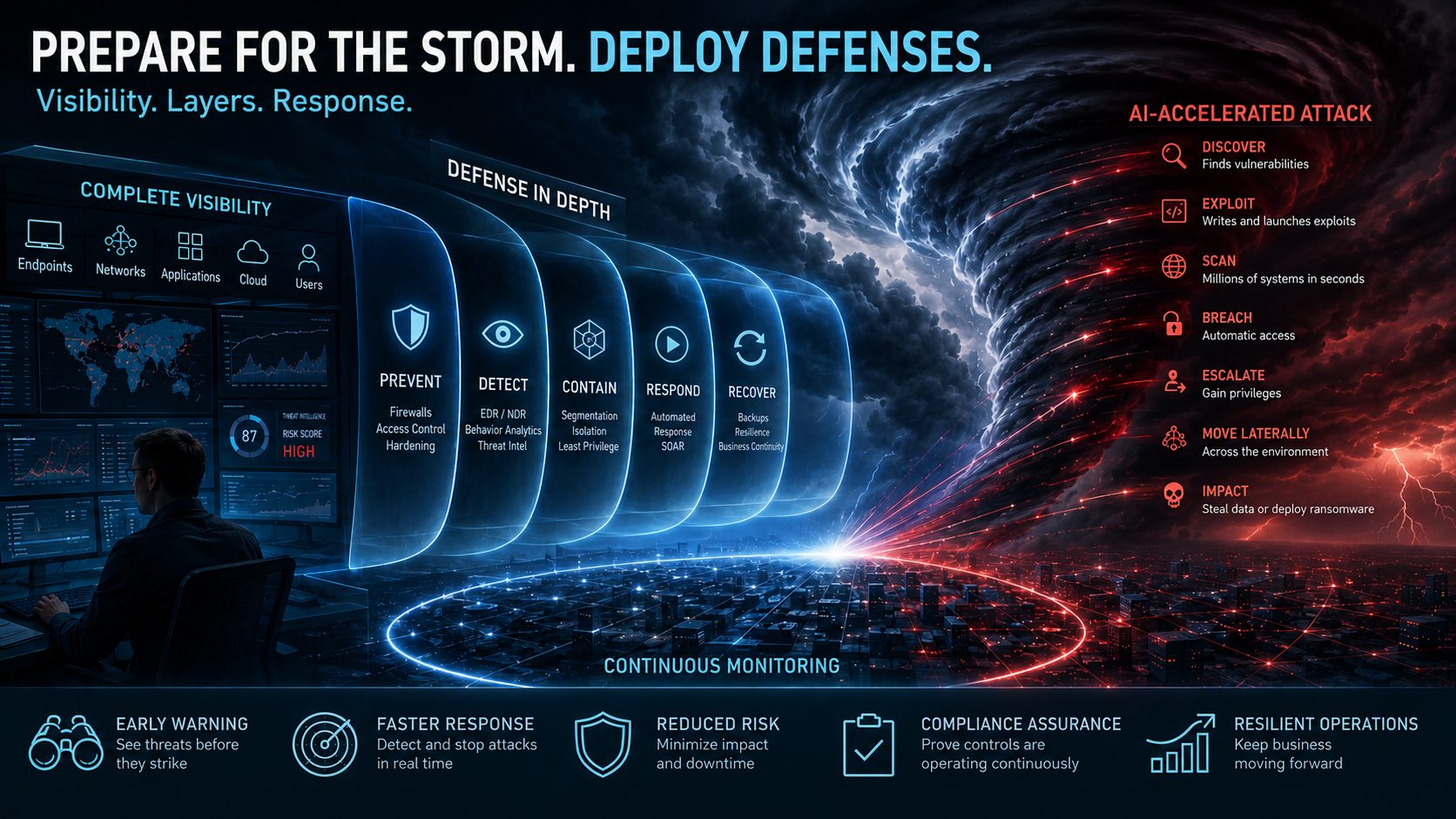
AI can identify the vulnerability, explain exactly why it exists, generate working exploit code, scan millions of Internet-facing systems, identify vulnerable organizations, gain initial access, escalate privileges, move laterally across networks, locate valuable assets, and launch ransomware or steal sensitive data—all before many organizations have completed patch validation and deployment.
The greatest change may not be the sophistication of the attack itself, but the disappearance of the defender’s response window.
Heighten your detection and response for this coming barrage.
Every Major Attack Becomes Faster
The Five Eyes agencies are not warning about a single new “AI attack.” They are warning that AI has the potential to accelerate nearly every phase of familiar cyberattacks. And, by some of our observations, it already has.
Vulnerability Exploitation
AI can rapidly analyze newly discovered vulnerabilities, generate proof-of-concept exploits, and adapt attack techniques automatically. What once required experienced exploit developers over several days could become largely automated.
Credential Theft
Instead of crude phishing emails, AI can create convincing messages tailored to specific organizations or individuals, dramatically improving credential theft campaigns through personalization, language fluency, and timing.
Ransomware
Modern ransomware already includes reconnaissance, lateral movement, privilege escalation, and data theft. AI can automate target selection, identify high-value systems more efficiently, optimize attack paths, and determine the greatest business impact before encryption begins.
Supply Chain Attacks
AI can examine software dependencies, identify weak third-party components, prioritize exploitable libraries, and help attackers discover indirect paths into larger organizations.
Critical Infrastructure
Healthcare, manufacturing, utilities, transportation, and industrial control systems could face accelerated reconnaissance and attack planning as AI quickly identifies exposed services, misconfigurations, outdated software, and operational weaknesses.
Data Theft
Rather than stealing everything indiscriminately, AI can search enterprise environments for the most valuable intellectual property, financial records, regulated data, or customer information before orchestrating efficient exfiltration.
Cybersecurity Becomes a Board-Level Risk
The Five Eyes warning reinforces a broader trend already underway: cybersecurity is no longer solely an IT responsibility.
When attack timelines shrink from weeks to hours, organizations have less opportunity to manually investigate alerts, validate patches, or coordinate responses. The effectiveness of security increasingly depends upon continuous monitoring, rapid detection, and automated response operating around the clock.
This elevates capabilities such as:
- Continuous vulnerability detection
- File integrity monitoring (FIM)
- Endpoint detection and response (EDR)
- Cloud workload protection
- Virtual patching
- Security automation, orchestration, and response (SOAR)
- Threat intelligence correlation
- Rapid containment and isolation
These are no longer simply compliance controls. They are becoming foundational business risk controls.
AI Requires AI-Assisted Defense
Organizations should adopt many of the same technologies as attackers.
Machine learning can identify anomalous behavior across thousands of endpoints far faster than human analysts alone. Automated playbooks can isolate compromised systems, update firewall policies, block malicious IP addresses, or create ServiceNow tickets within seconds of detection. Human expertise remains essential, but increasingly focuses on validating, directing, and improving automated security operations rather than performing every task manually.
This is where human-in-the-loop (HITL) governance becomes especially important. AI can dramatically improve security operations, but high-impact decisions should remain subject to human oversight to reduce operational risk and prevent unintended disruption.
Building Defense in Depth for AI-Accelerated Attacks
No single security product can stop AI-assisted attacks. Organizations instead need multiple defensive layers working together across endpoints, workloads, applications, and infrastructure.
Web application firewalls (WAFs) help prevent exploitation at the application edge by blocking malicious HTTP requests, injection attacks, and many attempts to exploit newly disclosed vulnerabilities through virtual patching.
Cloud workload protection continuously monitors cloud servers, virtual machines, and containerized workloads for runtime attacks, misconfigurations, and unauthorized activity.
Endpoint detection and response provides continuous visibility into servers and endpoints, detecting abnormal behavior, privilege escalation, lateral movement, malware execution, and persistence techniques before attackers can spread throughout the environment.
Together, these technologies reduce attacker dwell time while increasing organizational visibility—a critical advantage when AI is compressing the speed of attack.
Preparing for the AI-Assisted Attack Storm
The warning from the Five Eyes agencies is less about predicting futuristic cyberwarfare than recognizing a change already beginning to unfold. As frontier AI matures, attackers will be able to discover vulnerabilities, generate exploits, launch campaigns, and adapt their techniques with unprecedented speed.
Organizations that continue relying on manual processes alone may find themselves reacting too slowly.
Atomicorp helps organizations prepare through layered cybersecurity that combines server hardening, EDR, file integrity monitoring, vulnerability detection, virtual patching, cloud workload protection, web application firewall protection, automated response, centralized SIEM visibility, and AI-assisted security operations with human oversight. Supporting modern, legacy, cloud, and operational technology environments alike, this defense-in-depth approach gives security teams the visibility, automation, and control needed to respond effectively as AI reshapes the cyber threat landscape.
Learn more.