
Protecting Industrial Operations from Legacy IT Security Risks
Legacy systems in OT environments often include aging Windows, Linux, and Unix-based computers that configure, monitor, and manage industrial equipment. These systems can introduce vulnerabilities into critical operations, while compatibility and uptime requirements complicate conventional security measures. Agentless EDR offers a way to extend continuous security and compliance monitoring to difficult-to-protect systems.
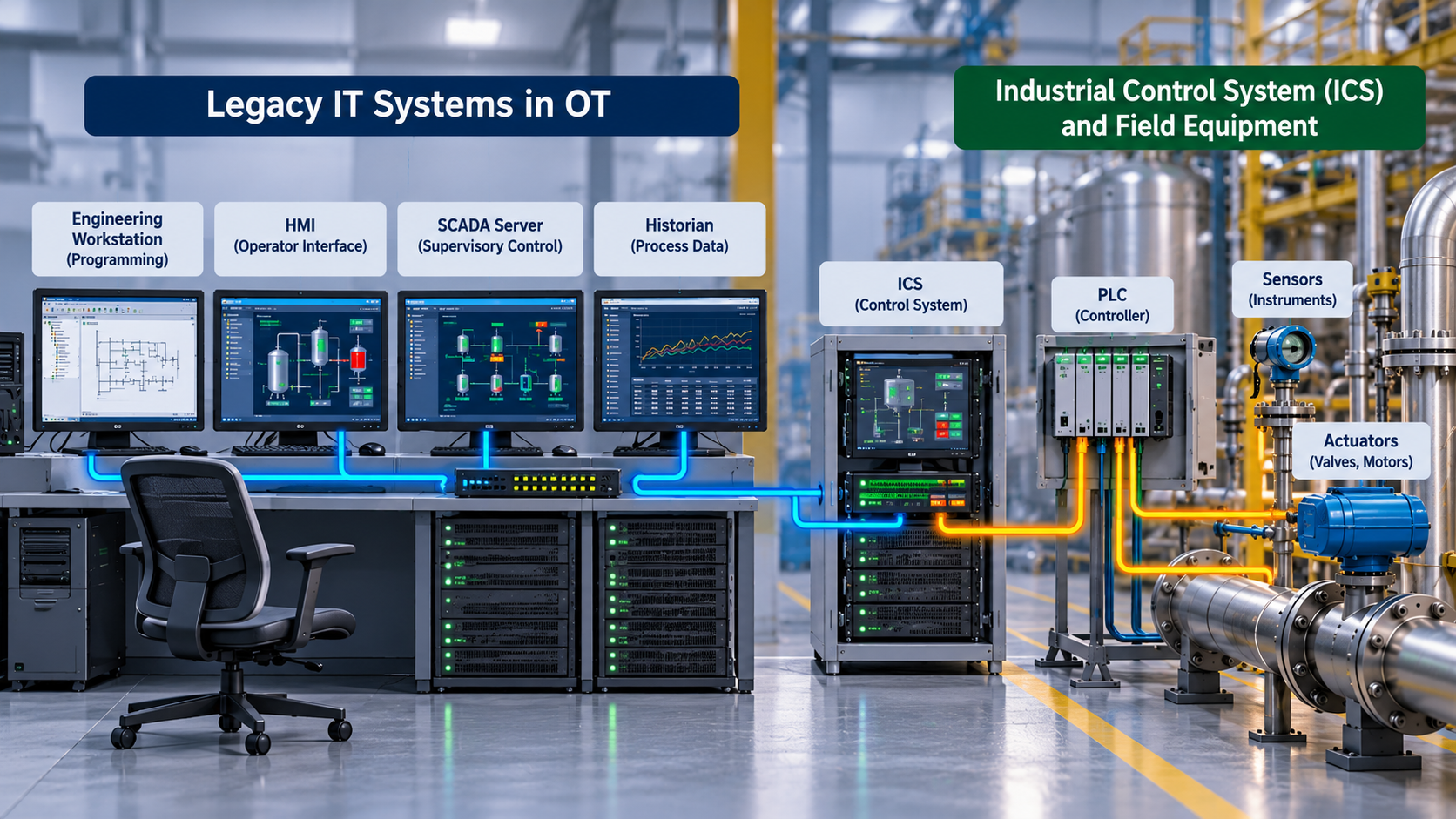
Industrial operations rely on more than programmable logic controllers (PLCs), sensors, and specialized equipment. Behind many industrial processes are engineering workstations, human-machine interfaces (HMIs), industrial control systems (ICSs), supervisory control and data acquisition (SCADA) servers, and other computers running conventional operating systems.
Some of these systems remain in service long after their software reaches end of life. Their continued operation may be essential, but their vulnerabilities can create security risks for the industrial equipment they manage.
Discover how Atomicorp can protect your IT/OT convergence points.
Where Legacy IT Systems and OT Converge
Information technology (IT) and operational technology (OT) serve different purposes. IT primarily manages business information and computing resources, while OT monitors and controls physical processes.
Yet industrial environments frequently depend on IT-based computers to configure equipment, supervise operations, collect data, and connect industrial networks with enterprise systems.
Important points of IT/OT convergence include:
- Engineering workstations: Usually Windows or Linux computers used to program and configure industrial controllers.
- HMIs: These are operator interfaces that display industrial conditions and provide supervisory control.
- Industrial control systems (ICSs): Broad systems encompassing the hardware, software, and networks used to monitor and control industrial processes, including PLCs, SCADA systems, and other control technologies.
- SCADA servers: Systems that coordinate monitoring and supervisory control across industrial assets.
- Industrial historians: Servers and other devices that collect process data for operational analysis, reporting, and business applications.
- Maintenance and management systems: Computers supporting remote access, administration, and software maintenance.
These systems can become security liabilities when operating systems, applications, or supporting components are outdated or no longer receive security updates.
How Legacy Systems in OT Create Security Risks
Consider an engineering workstation running an unsupported Windows operating system because its industrial programming application is incompatible with newer versions. An attacker who compromises that workstation might gain access to software, credentials, or communications used to manage industrial controllers.
The PLC itself does not need to contain the original vulnerability. A compromised legacy computer trusted to communicate with the PLC can become the pathway to industrial equipment. Similar risks arise when attackers exploit vulnerable HMIs, ICSs, SCADA servers, historians, or remote maintenance systems. Potential consequences include unauthorized configuration changes, interrupted operations, loss of process visibility, and compromised industrial data.
Network segmentation, access restrictions, and patch management reduce these risks. However, replacing or updating legacy systems may require expensive engineering work, vendor recertification, or operational downtime.
Traditional endpoint detection and response (EDR) typically relies on software agents installed directly on protected computers. Agents provide detailed visibility into processes, files, applications, and system activity. But installation may be impractical on legacy systems in OT environments.
Common obstacles include:
- Unsupported operating systems or incompatible security software
- Limited computing resources and specialized applications
- Vendor restrictions on installing third-party software
- Strict uptime requirements and limited maintenance windows
- Operational concerns about changes to validated industrial configurations
These limitations can leave critical systems without adequate endpoint monitoring.
Explore Atomicorp security solutions for legacy and end-of-life systems.
Visit the legacy system security page.
Agentless EDR for Continuous Security and Compliance Monitoring
Agentless EDR offers another approach by collecting and analyzing available security information without installing monitoring software directly on every protected system.
Depending on system capabilities and available access, agentless monitoring may collect security logs, authentication events, configuration information, and other telemetry. This enables the EDR engine to send alerts and organizations to identify suspicious activity, investigate unauthorized changes, and maintain security visibility across systems that cannot accommodate conventional agents.
Continuous monitoring from agentless EDR also supports compliance activities by generating records relevant to access controls, audit logging, configuration management, and vulnerability oversight. Frameworks such as NIST SP 800-82, IEC 62443, and NERC CIP emphasize security practices applicable to industrial environments, although specific requirements vary by framework and organization.
Agentless monitoring does not necessarily provide the same depth of detection or response as an installed agent. Its effectiveness depends on the information and controls available from each system.
Experience the difference.
Extending Atomic OSSEC Security to OT and Legacy IT
Atomic OSSEC provides agent-based and agentless endpoint security options for environments that include legacy Windows, Linux, Unix, and other difficult-to-protect systems. Its security monitoring capabilities include intrusion detection, centralized log analysis, file integrity monitoring, vulnerability detection, and compliance reporting.
Organizations can use these capabilities to strengthen visibility into aging IT infrastructure supporting industrial operations while applying monitoring approaches appropriate to individual systems.
If an agented deployment is not possible or an agentless configuration is preferred, Atomic OSSEC enables workload devices to send log events to the hubs via the syslog protocol. Hub servers can also log into and inject ephemeral code into the workload to collect information, and to carry out active response activities. Other devices, such as network switches and firewalls that don’t support the installation of an agent, can send log data directly to the hub. These collected events can then be analyzed and correlated through Atomic OSSEC’s integrated SIEM capabilities for centralized security monitoring.
By combining agent-based and agentless protection, organizations can extend continuous security and compliance monitoring across modern IT infrastructure, legacy computing environments, and the IT systems supporting OT.
Learn more about Atomicorp’s agentless EDR capabilities.