
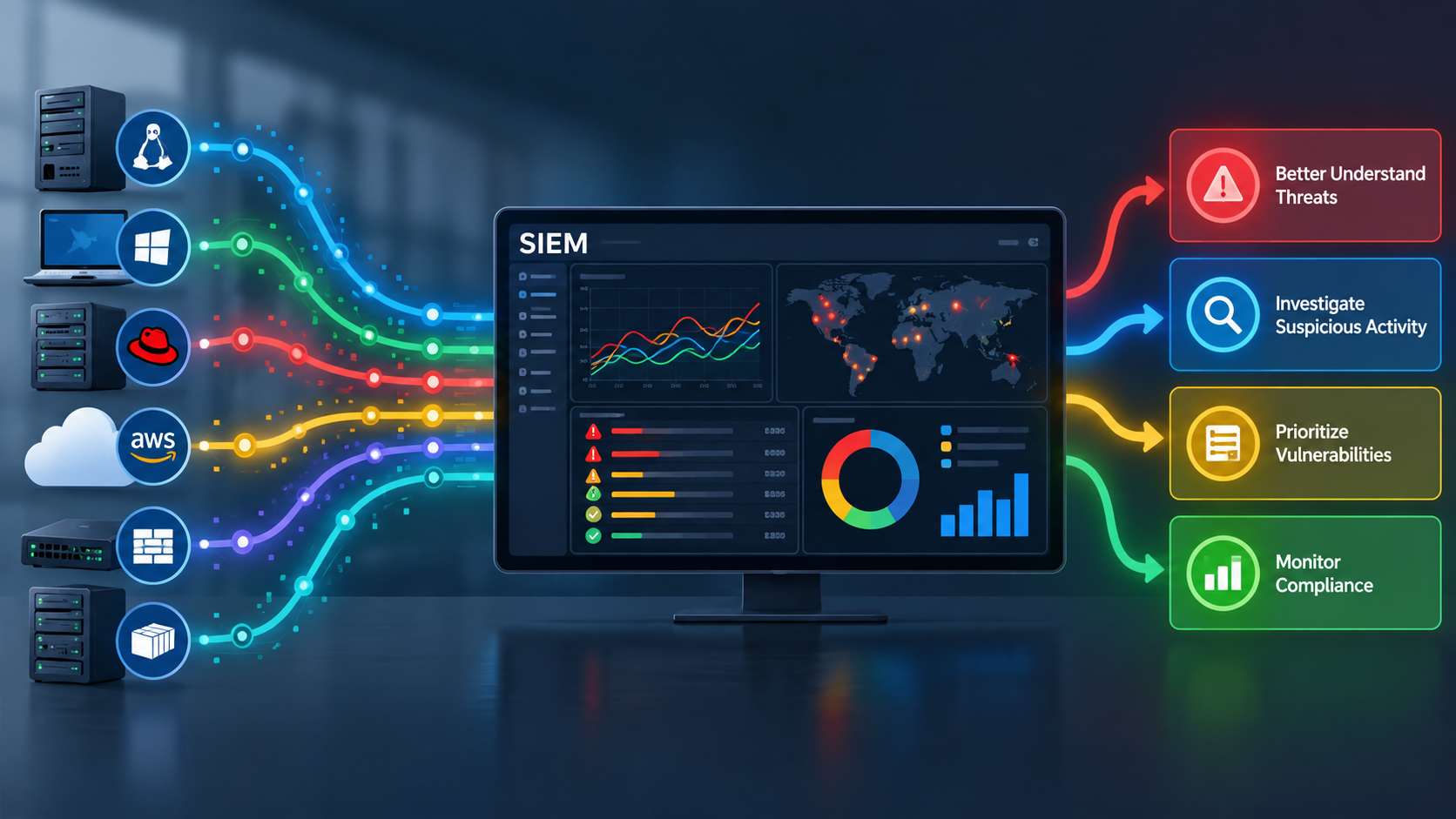
SIEM Security Monitoring: Turn Security Data Into Action
Leverage SIEM security monitoring in an endpoint detection and response (EDR) system that provides multi-SIEM and multiplatform flexibility.
What Is SIEM Security Monitoring?
Security information and event management (SIEM) brings security events, logs, and other telemetry together so organizations can detect threats, investigate activity, monitor compliance, and respond more effectively. Instead of viewing security activity one system at a time, centralized security monitoring can provide a broader picture of security performance and posture.
Consider two suspicious events occurring in different parts of a business. A series of failed login attempts on one system might not appear related to an unauthorized file change on another. Viewed together with other activity, however, they could reveal different stages of the same attack.
That context also helps security teams distinguish legitimate concerns from routine activity and false alarms. A SIEM graphical user interface (GUI) can organize and prioritize security events by severity, affected system, time, source, and other attributes to help analysts understand what requires attention.
From Security Events to SIEM Threat Detection
SIEM can operate as a standalone platform or as part of a broader security system such as endpoint detection and response (EDR). Cloud providers and other security platforms can also provide SIEM-like visibility through dashboards, reports, and portals.
The underlying concept is similar: collect and aggregate security data from sources such as servers, workstations, virtual machines, network devices, cloud workloads, and applications. Depending on the source, that data can help answer important questions: Where did an event occur? What happened? Who or what made a change? Is a system showing signs of compromise?
That makes SIEM threat detection more than log collection. Correlating and visualizing security information can help reveal patterns that might be difficult to recognize when individual alerts and events are viewed separately.
Visit the endpoint detection and response (EDR) page.
Combine SIEM and EDR
An integrated SIEM and EDR approach can connect centralized visibility with endpoint-level detection and response. The SIEM helps provide context, while the EDR system supplies detailed endpoint telemetry and can take action when threats are detected.
Intrusion detection, for example, can identify signs of attacks or suspicious activity and feed those events into the SIEM. Antivirus and antimalware capabilities can contribute additional information about malicious files and activity.
File integrity monitoring (FIM) adds another important layer. Instead of simply reporting that something happened, FIM data can help establish what file changed, when it changed, and who or what was responsible. This information supports both threat investigations and compliance requirements.
Vulnerability and CVE detection adds security posture information as well. Knowing that suspicious activity occurred on an endpoint is important. Knowing that the same endpoint also contains exploitable vulnerabilities gives defenders additional context for prioritizing investigation and remediation.
Check out the Atomicorp CVE Research tool.
Atomic OSSEC Brings Endpoint Security Data Together
Atomic OSSEC combines EDR capabilities with integrated SIEM functionality across modern, cloud, legacy, and end-of-life systems. It brings endpoint security information into a centralized view while providing the flexibility to use the Atomic OSSEC SIEM or integrate security data with other platforms.
Security teams can use SIEM data from Atomic OSSEC to:
- Detect suspicious activity. Bring intrusion detection, antivirus and antimalware findings, and other security events into a centralized view.
- Track file and system changes. Use FIM data to identify what changed, when it changed, and who or what was responsible.
- Prioritize vulnerabilities: Add CVE and vulnerability information from monitored endpoints to provide context for investigation and remediation.
- Monitor compliance: Identify where security controls associated with frameworks such as NIST and PCI DSS are not being met.
- Drive response: Send security alerts to SIEM, SOAR, collaboration, and other platforms to support automated or analyst-led responses.
Organizations are not limited to Atomic OSSEC’s native SIEM. Atomic OSSEC can also integrate with external platforms such as Splunk, OpenSearch, and Sumo Logic, giving organizations more flexibility to incorporate endpoint security data into existing security operations.
Centralize Security Monitoring—and Act on It
Security tools generate enormous amounts of information, but isolated events provide only part of the picture. SIEM security monitoring brings that data together so organizations can better understand threats, investigate suspicious activity, prioritize vulnerabilities, and monitor compliance.
Combining SIEM with an EDR system takes the next step by connecting centralized visibility with endpoint detection and automated response. The result is not simply more security data, but more context for deciding what matters and what to do about it.