
The WAF Blind Spot: What Basic Web Application Protection Can Miss
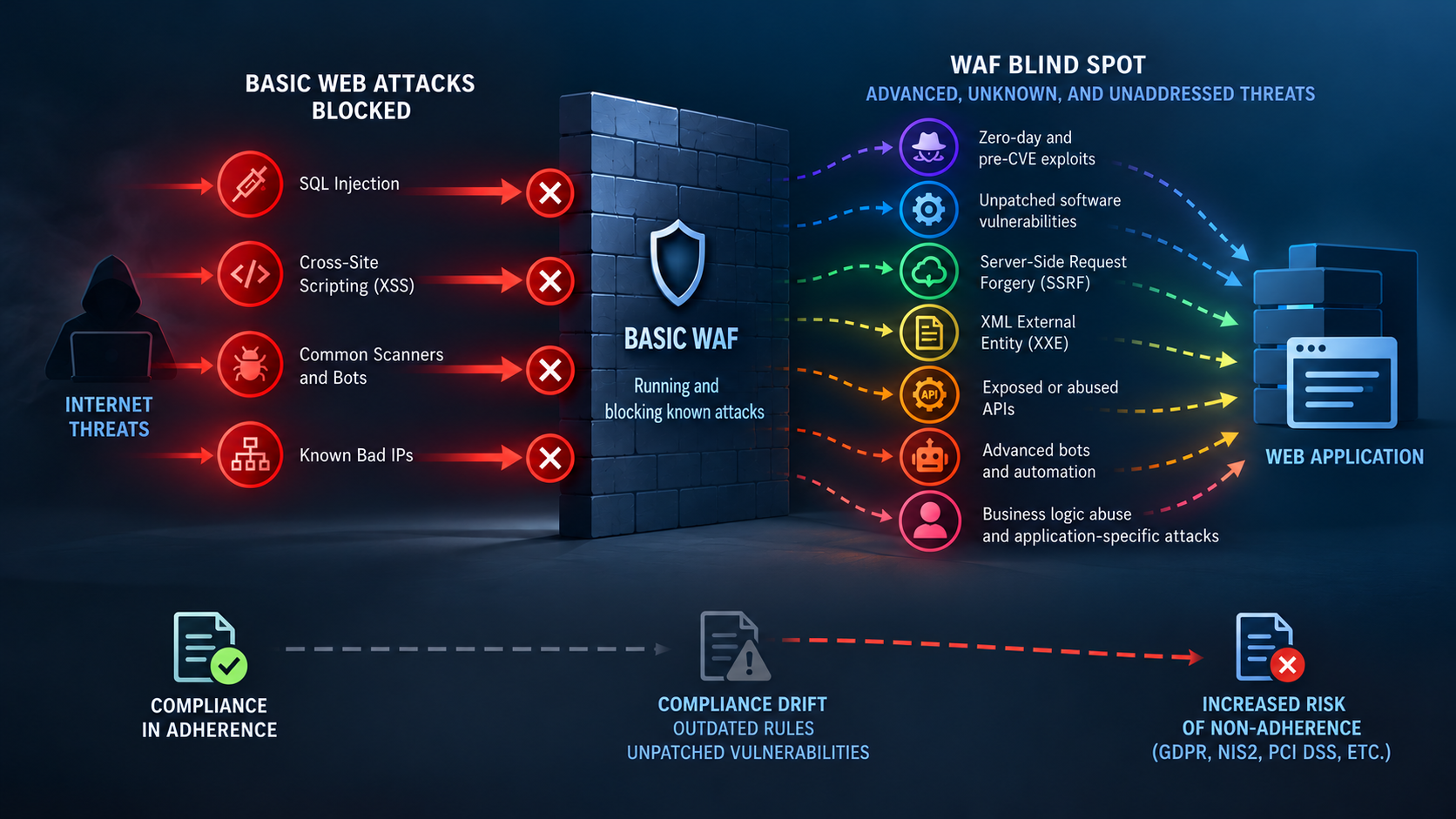
A WAF can be running, correctly configured, and blocking known attacks while still leaving significant gaps in application security.
Limited inspection, outdated WAF rules, exposed APIs, and unpatched software vulnerabilities can create security gaps that attackers may exploit. For enterprises, CDN providers, and security integrators, effective web application protection requires more than baseline OWASP Top 10 defenses. Deep inspection, continuously updated threat intelligence, virtual patching, and application-specific security controls help close the gaps that basic WAF deployments may miss.
Learn more about Atomicorp’s new daily protection loop, which identifies vulnerabilities, analyzes exploits, and develops WAF blocking rules to help protect applications even before a CVE number is assigned or a software patch becomes available.
Visit the Atomicorp CVE Research tool page.
The Threats Your WAF Doesn’t See
A web application firewall (WAF) inspects HTTP and HTTPS traffic to identify and block malicious requests before they reach protected applications. But the effectiveness of that inspection depends on what the WAF can see, the rules it applies, and how those rules are configured.
Basic WAF protection typically addresses common attack categories such as SQL injection (SQLi) and cross-site scripting (XSS). These protections remain essential, but enterprise applications present a much wider range of potential weaknesses.
For example, a generic rule might recognize a suspicious request pattern without understanding whether the request violates an application’s intended behavior. An application-specific policy can go further, restricting unexpected parameters, HTTP methods, or access to sensitive endpoints.
Inspection granularity matters because different applications have different risks. A customer portal, payment application, content management system, and public API may require distinct security policies.
Deployment architecture also affects what a WAF can inspect and control. Cloud-delivered WAFs, reverse proxies, and web-server deployments can all provide deep inspection when properly configured. The important questions are whether the WAF has access to the necessary request data and whether its policies can be tailored to individual applications.
Want the benefits of advanced ModSecurity WAF protection, daily security rule updates, and virtual patching without the complexity of rule integration, tuning, and ongoing maintenance?
Contact Atomicorp to learn how we simplify WAF deployment and management.
Yesterday’s WAF Rules Against Today’s Attacks
Another WAF blind spot appears when security rules fail to keep pace with emerging threats. New vulnerabilities are continually discovered in web applications, frameworks, plugins, and supporting software. Meanwhile, attackers continue to exploit older Common Vulnerabilities and Exposures (CVEs), particularly when affected software remains unpatched.
An outdated ruleset may continue blocking familiar attack signatures while failing to recognize newer exploit techniques or application-specific weaknesses.
This is especially concerning for legacy and end-of-life (EOL) applications. Some systems cannot be patched because updates are unavailable, incompatible, or too disruptive to operations. Yet these applications may remain essential to business processes.
Virtual patching helps address this problem. A WAF can apply rules that block known exploit patterns before a vulnerability is corrected in the underlying application. Virtual patching does not eliminate the vulnerability, but it can reduce exposure while organizations prepare a permanent fix—or maintain compensating controls when patching is impossible.
Threat intelligence and frequent rule updates are equally important. Intelligence gathered from attacks, malicious IP activity, vulnerability research, and customer-reported incidents can help security teams identify emerging risks.
However, frequent updates alone are not enough. Rules must also be tested to determine whether they block malicious requests without disrupting legitimate application traffic.
Bots, APIs, and the Expanding Attack Surface
Not every web application attack resembles a traditional injection attempt. Automated bots can probe applications for weaknesses, attempt stolen credentials, scrape sensitive information, or overwhelm login and API endpoints. Some malicious requests may look similar to legitimate traffic, making detection and enforcement more complicated.
Enterprise web application protection therefore needs controls that address how applications are used, not just whether individual requests contain suspicious signatures.
These controls may include:
- Bot and brute-force protection to identify and restrict automated abuse.
- Daily protection loop to detect vulnerabilities, reverse-engineer exploits, and create WAF blocking rules that keep you protected until a patch can be applied.
- API security policies to enforce approved request methods, parameters, and data structures.
- Application control, which includes custom allowlists and blocklists to restrict access based on IP addresses or other defined criteria.
- Geolocation-based controls to apply geographic access restrictions where appropriate.
APIs deserve particular attention because they expose application functionality directly to software clients. A request can follow the correct syntax but violate an application’s access or usage policies.
For APIs with documented specifications, OpenAPI-based rules can help to enforce expected request structures. This adds another layer of protection beyond general-purpose WAF signatures, although it does not replace authentication, authorization, or secure application design.
Find out how Atomicorp’s advanced EDR and WAF rules can provide a continuous protection loop against vulnerability exploits and other attacks: monitor, detect, prevent, protect, respond, report, in a process that proactively uncovers vulnerabilities before they become CVEs.
The Hidden Risks of Limited WAF Control
For enterprises, CDN providers, and security integrators, the WAF blind spot can extend beyond threat detection. Security teams need visibility into what the WAF blocks, what it allows, and why. Without useful logs, reporting, and security information and event management (SIEM) integration, investigating suspicious activity is difficult.
False positives present another operational challenge. Overly aggressive rules can interfere with legitimate customers, applications, or API integrations. Excessive exceptions, on the other hand, may weaken protection. Effective WAF management requires a balance between detection accuracy, timely rule tuning, and application availability.
Deployment flexibility also matters. Some organizations prefer cloud-delivered protection, while others require customer-controlled infrastructure, local threat intelligence, or greater control over security logs and sensitive traffic. For CDN and hosting providers, the ability to integrate WAF protection into existing infrastructure and maintain separate customer policies can be particularly valuable. These are not simply administrative conveniences. They determine whether security controls can be adapted to changing applications, customer requirements, and operational risks.
Compliance adds another consideration. PCI DSS Requirement 6.4.2 calls for automated technical protection against web application attacks. A WAF can help satisfy this requirement, but WAF deployment alone does not establish PCI DSS compliance.
In addition, a software-based WAF appliance gives CDN providers, managed service providers, and enterprises greater control over where web traffic is inspected and security data is stored, helping preserve data sovereignty. This deployment flexibility supports data governance and cybersecurity obligations under regulations such as GDPR and NIS2.
Closing the WAF Blind Spot
A strong web application security and WAF strategy begins by recognizing that basic attack blocking is only one part of enterprise web application protection. Organizations should evaluate the depth of request inspection, coverage of application-specific threats, frequency and quality of rule updates, virtual patching capabilities, API security, threat intelligence, and operational visibility.
They should also consider how easily protection can be integrated into existing infrastructure and adapted as applications evolve.
Atomicorp addresses many of these requirements through its commercial Atomic ModSecurity Rules and Atomic WAF solutions. Commercial rules receive daily updates informed by vulnerability research and threat intelligence, supporting protection against common web attacks and known exploit techniques.
These Atomicorp products also provide virtual patching, customizable security rules, and application-layer controls designed to help protect modern and legacy web applications. Its ModSecurity integration options allow technology providers and security integrators to incorporate advanced WAF rules into their own environments and services.
No WAF can guarantee that every attack will be stopped. But organizations can reduce exposure by demanding more than a functioning firewall and a familiar list of protections.
The real WAF blind spot is assuming that because attacks are being blocked, the applications behind the firewall are fully protected. Discover what your WAF might be missing and how Atomicorp’s continuous protection loop identifies vulnerabilities, analyzes exploits, and develops new defenses.
Learn more about Atomic ModSecurity Rules, Atomic WAF, and how Atomicorp helps organizations and technology partners strengthen web application security.