
Atomicorp Blocked wp2shell Exploit Before It Had a Name
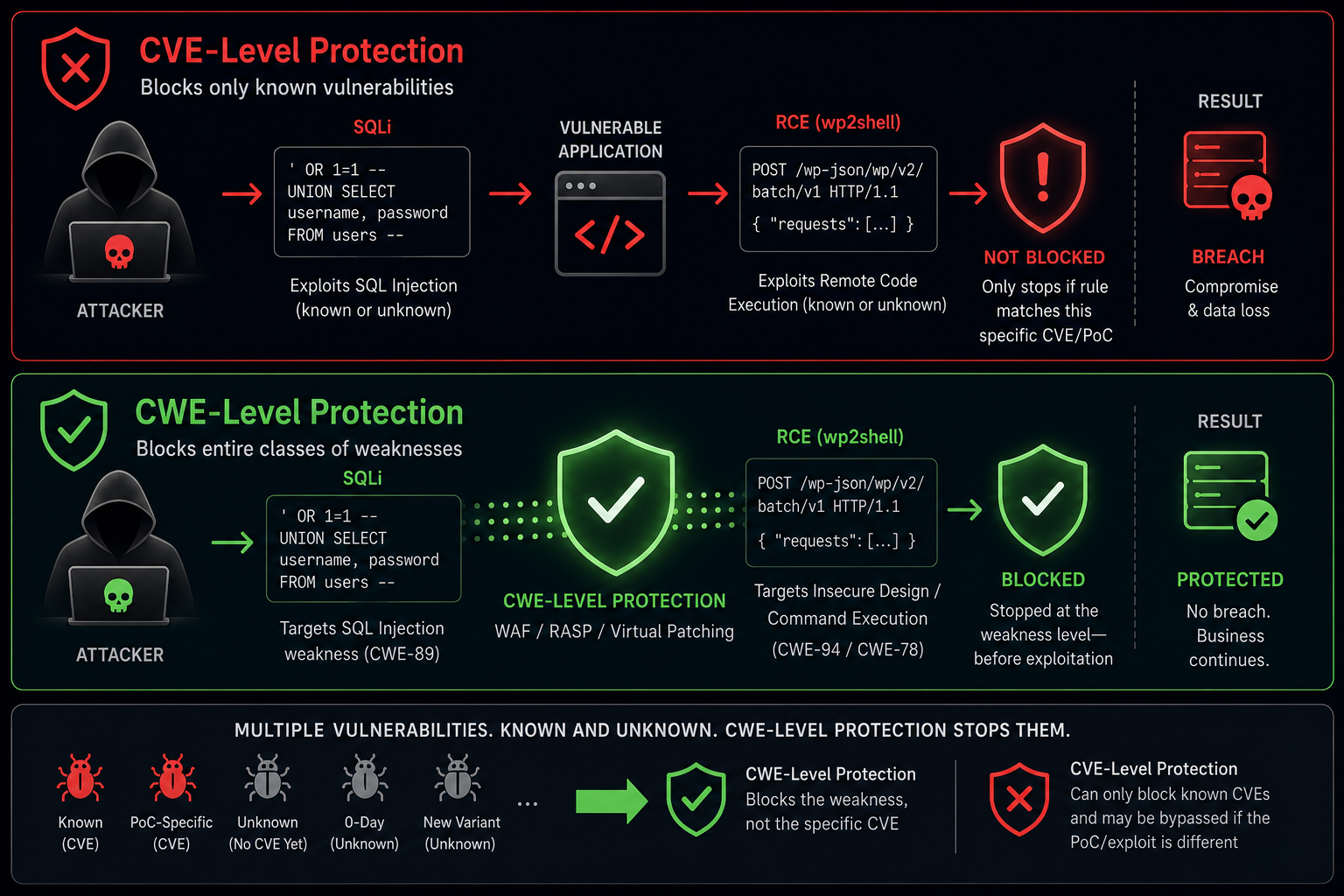
CWE-first protection wins again. While the industry raced to publish emergency wp2shell detections, Atomicorp’s existing generic SQL injection and RCE protections were already positioned to stop the underlying attack behavior.
wp2shell: The attack was new. The weakness was not.
The wp2shell chain combines CVE-2026-63030, a WordPress REST batch-route interpretation conflict, with CVE-2026-60137, an SQL injection in WP_Query. Together, they provide a path from an unauthenticated request to remote code execution on affected WordPress systems, which include 6.9.0–6.9.4 and 7.0.0–7.0.1, with security fixes released immediately on July 17, 2026, in versions 6.9.5 and 7.0.2. The related SQL injection vulnerability also affected WordPress 6.8.x and was addressed through the 6.8.5 and 6.8.6 security releases [1][2][3].
Atomicorp tested the public exploit structure against its existing commercial ruleset. No WordPress-specific, endpoint-specific, parameter-specific, or CVE-specific emergency signature was added. Every malicious exploit class exercised by the public tooling was blocked, while benign batch and author exclusion traffic remained available.
This was not a PoC signature win
The blocking rules did not depend on the WordPress product name, /batch/v1, author_exclude, either CVE number, or a copied wp2shell payload. They recognized generic SQL injection and RCE behavior after normalization. This was not a proof of concept (PoC) win, this was proof of efficacy.
Block vulnerability exploits even when you can’t patch.
Learn more about Atomicorp virtual patching.
Why CWE-first changes the protection timeline
| Dimension | CVE-chasing model | Atomicorp CWE-first model |
|---|---|---|
| Protection begins | After disclosure and emergency rule development | Before disclosure, when the attack class is already covered |
| Detection target | Product, route, parameter, or known payload | Normalized malicious behavior and reusable attack primitives |
| Variant resilience | Limited to anticipated exploit forms | Designed to span products, encodings, and delivery paths |
| Operational burden | Repeated emergency signature releases | Fewer, broader protections with ongoing tuning |
| False-positive control | Often overfits the PoC or disables a feature | Blocks malicious behavior while preserving benign use |
VALIDATION
Every tested exploit class was blocked.
The validation used multiple versions of the actual attack classes in the vulnerabilities along with testing benign behavior to ensure there were no false positives.
Atomicorp allowed both benign controls and blocked all malicious exploit classes. The result demonstrates both attack coverage and false-positive discipline: the rules did not disable WordPress batch functionality merely because attackers can abuse it.
Coverage extended through the RCE chain
Atomicorp blocked the oracle-building, blind extraction, time-delay, SQLi attacks, UNION extraction, and UNION ALL object-forging stages in the vulnerabilities and those used in all public exploits. The attack did not need to match one fixed payload to be stopped.
MARKET IMPACT
The wp2shell exploit, and the emergency update Atomicorp customers did not need.
The wp2shell disclosure triggered emergency WAF activity across the market. Cloudflare published an emergency managed-rule release for the unauthenticated RCE and SQL injection chain. Akamai deployed a new Rapid Rule for chain-specific variants while also noting baseline coverage from its generic SQL injection engine.[4][5]
Atomicorp did not need to add a wp2shell rule to block the public exploit classes or the general methods needed to exploit the vulnerabilities. Its existing commercial protections already covered the underlying CWE-89 SQL injection and related RCE behavior. That is the operational advantage of building protection around weaknesses and attack primitives instead of waiting for every new CVE headline.
| Protection before disclosure
Coverage starts with the attack class, not with an emergency advisory. |
Less brittle rule growth
Reusable protections reduce dependence on narrow, PoC-shaped signatures. |
Benign traffic preserved
Atomicorp blocked the attack without shutting off the WordPress batch API. |
What customers should do:
- Keep Atomicorp commercial protections enabled and current across supported ModSecurity deployments.
- Patch affected WordPress installations immediately; WAF protection closes the exploitation window but does not replace the vendor fix.
- Review WAF and application logs for blocked attempts and possible activity before patching.
Built for the weakness, not the headline
The vulnerability identifiers were new. The SQL injection and RCE behaviors were not. Atomicorp recognized the attack, blocked every tested exploit class, and preserved legitimate application behavior – without waiting for an emergency CVE-specific rule.
Explore Atomicorp ModSecurity and WAF solutions.
Sources
[1] NVD: CVE-2026-63030, Interpretation Conflict in the WordPress REST batch API.
[2] NVD: CVE-2026-60137, SQL injection in WordPress WP_Query.
[3] WordPress 7.0.2 security release, July 17, 2026.
[4] Cloudflare emergency WAF release, July 17, 2026.
[5] Akamai analysis and Rapid Rule response, July 20, 2026.
[6] Public wp2shell proof-of-concept by 0xsha.
[7] Atomicorp validation performed July 22, 2026 against a controlled synthetic target.