
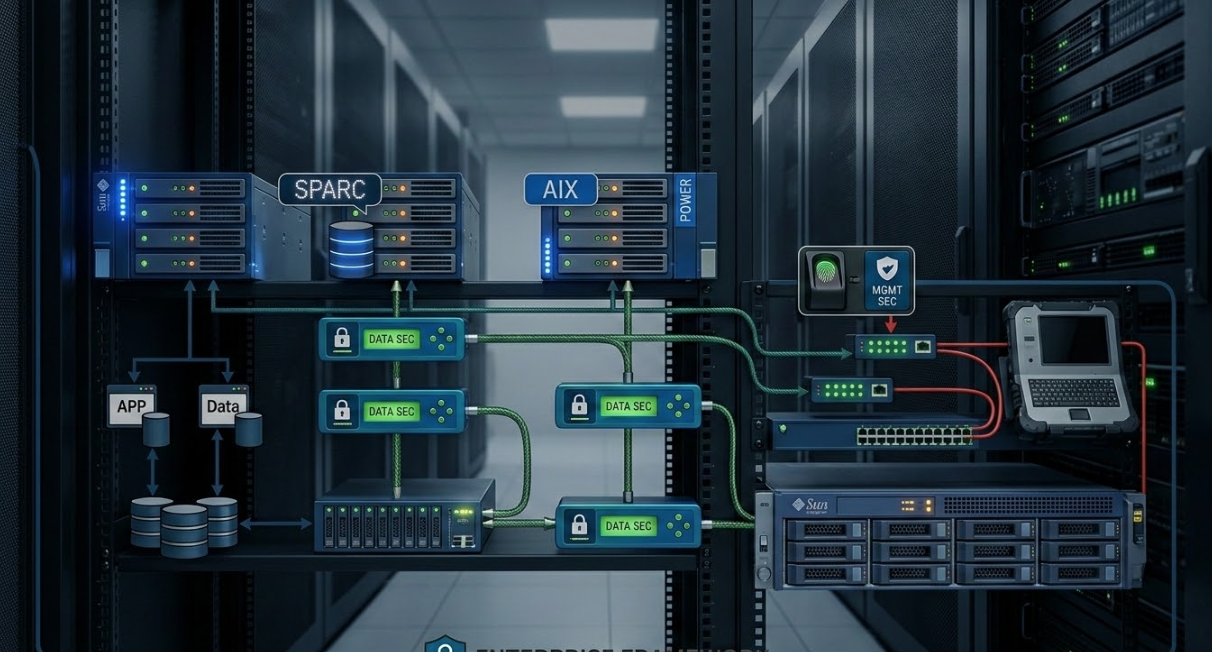
Unix System Security: Real-Time FIM, CVE Detection, and Compliance for Legacy AIX and Solaris
Atomicorp has expanded coverage for legacy Unix system security by delivering both real-time file integrity monitoring (FIM) and CVE detection and correlation for AIX and Solaris platforms. These extra-edge capabilities deliver the visibility, monitoring, and compliance controls organizations need to secure business-critical systems beyond vendor support lifecycles, reduce risk, and avoid operational disruption.
AIX, Solaris and Unix System Security for Continuity
Despite the industry’s focus on cloud-native applications and modern Linux environments, AIX and Solaris continue to support critical workloads across finance, telecommunications, manufacturing, healthcare, utilities, government, and operational technology (OT) environments.
Many of these systems power enterprise databases, ERP platforms, industrial control systems, proprietary business applications, and other infrastructure that organizations depend on every day. Because these environments often require specialized hardware, custom software, or lengthy validation processes, replacing them is not always practical or cost-effective.
As a result, organizations frequently continue operating AIX and Solaris systems long after mainstream cybersecurity vendors have stopped supporting them.
Discover how Atomicorp can help protect long-performing legacy and EOL systems. Check out the dedicated AIX and Solaris security and compliance pages from Atomicorp.
Explore the Solaris security page.
The Security Gap Facing Legacy Unix Systems
As operating systems age, security teams often find themselves caught between operational requirements and cybersecurity realities.
Vendor support eventually declines or disappears. Security updates become less frequent or stop entirely. Modern endpoint security tools often lack compatibility with older operating systems, leaving organizations with limited visibility into critical systems that remain connected to enterprise networks.
At the same time, compliance requirements do not disappear simply because a platform has reached end of life.
Organizations running AIX, Solaris, legacy CentOS and RHEL deployments, and other Unix-based systems—including HP-UX and BSD variants—must still demonstrate appropriate security controls, vulnerability management, monitoring, auditability, and incident response capabilities.
This creates a growing need for modern security controls that continue to function effectively on aging platforms.
Check out the Atomicorp legacy system security page. (We support legacy and end of life Windows operating systems, too.)
Learn more about our EDR solution, Atomic OSSEC
Real-Time File Integrity Monitoring for AIX and Solaris
One of the most important recent enhancements to Atomic OSSEC is the availability of real-time file integrity monitoring (FIM) for AIX as well as Solaris environments.
File integrity monitoring provides continuous visibility into changes occurring across critical operating system files, application files, configurations, and security-sensitive assets.
Rather than relying solely on scheduled scans, real-time FIM continuously monitors systems and immediately identifies unauthorized or unexpected modifications.
This capability helps organizations detect:
- Unauthorized file changes
- Configuration drift
- Malware activity
- Insider threats
- Policy violations
- Unexpected system modifications
For legacy Unix systems, where visibility is often limited, real-time FIM provides an early warning system that helps security teams identify potential compromise before operational disruption occurs.
It also supports numerous compliance requirements related to system integrity, auditability, change management, and continuous monitoring.
Explore the file integrity monitoring in the Atomic OSSEC EDR system.
CVE Detection and Correlation for AIX and Solaris
Security monitoring alone is not enough. Organizations also need visibility into known vulnerabilities affecting critical systems.
Atomicorp now delivers CVE detection and correlation capabilities for Solaris and AIX platforms, helping security teams identify known vulnerabilities and assess risk across legacy infrastructure.
As unsupported operating systems continue to accumulate exposure to newly discovered vulnerabilities, many organizations struggle to determine which systems are affected and how to prioritize remediation efforts.
Atomic OSSEC helps address this challenge by providing:
- Vulnerability detection
- CVE correlation
- Security monitoring
- Centralized visibility in a SIEM with GUI
- Risk prioritization
- Reporting and compliance support
This capability is particularly valuable for organizations operating legacy Solaris and AIX deployments that may no longer receive regular vendor updates but continue to support critical business operations.
Continuous vulnerability visibility allows organizations to make informed risk management decisions while documenting ongoing security efforts for internal stakeholders and auditors.
Check out the all new vulnerability scanner in Atomic OSSEC v7.0.
Visit our Vulnerability Detection page.
Compliance Support for Legacy Unix Environments
Legacy systems remain subject to many of the same compliance requirements as modern infrastructure.
Organizations operating AIX and Solaris systems may still need to demonstrate adherence to frameworks and standards such as:
- NIST 800-53
- NIST 800-171
- NIST 800-82
- PCI DSS
- ISO/IEC 27001
- IEC 62443
- HIPAA
- NERC CIP
- GDPR
- NIS2
Many of these frameworks require controls related to:
- File integrity monitoring
- Vulnerability management
- Audit logging
- Incident detection
- Change management
- Continuous monitoring
- Privileged access oversight
Atomic OSSEC helps organizations implement and document these controls while maintaining operational continuity for systems that cannot easily be retired or replaced.
Comprehensive Security Beyond FIM and Vulnerability Detection
In addition to real-time FIM and CVE detection, Atomic OSSEC provides a broad set of security capabilities designed to support both modern and legacy environments.
These include:
- Endpoint detection and response (EDR)
- Intrusion detection and prevention (IDS/IPS)
- Antivirus and antimalware protection
- Log monitoring and analysis
- Active response automation
- Data loss prevention (DLP)
- Compliance reporting
- Centralized management and dashboards
Together, these capabilities provide layered security for systems that often fall outside the support boundaries of traditional cybersecurity vendors.
Protecting Legacy Applications Through Virtual Patching
Operating system security is only part of the challenge. Many organizations continue to rely on legacy web applications, proprietary software platforms, and business-critical systems that cannot easily be modified or patched.
Atomicorp addresses this challenge through Atomic WAF and Atomic ModSecurity Rules, which provide virtual patching capabilities that help protect vulnerable applications without requiring changes to source code.
Virtual patching can help shield:
- Legacy web applications
- Proprietary business software
- Oracle-based environments
- Inventory systems
- Customer-facing applications
- Internal business portals
For organizations that cannot immediately modernize critical software, virtual patching provides an additional layer of defense against known attack techniques.
Learn more about Virtual Patching.
Check out Atomicorp’s Atomic ModSecurity Rules or the Atomic WAF software appliance.
Affordable Security Monitoring for Legacy Systems
Many cybersecurity vendors have moved on from AIX and Solaris. The systems themselves, however, continue to support critical business operations around the world.
By delivering affordable real-time file integrity monitoring, CVE detection and correlation, compliance monitoring, EDR capabilities, and virtual patching, Atomicorp helps organizations strengthen security across legacy Unix environments without sacrificing operational continuity.
For organizations seeking practical ways to secure AIX, Solaris, and other long-lived systems, modern security controls remain achievable. This can be true even when the underlying operating system has reached the end of its support lifecycle.
Visit the Atomic OSSEC EDR page.