
Who—or What—Changed That File? File Change Monitoring for Modern Security
File change monitoring can tell organizations much more than whether an important file was modified. Modern file integrity monitoring (FIM) can provide valuable event data about what changed, when and where it happened, and who or what was responsible. Combined with real-time monitoring and other security telemetry, this information can help security, IT, OT, and compliance teams distinguish legitimate activity from mistakes, configuration drift, and potentially malicious behavior.
File Change Monitoring: Who—or What—Did It?
For years, the fundamental question behind file integrity monitoring was relatively straightforward:
Did something change?
That remains important, but today’s IT environments make the next questions increasingly valuable.
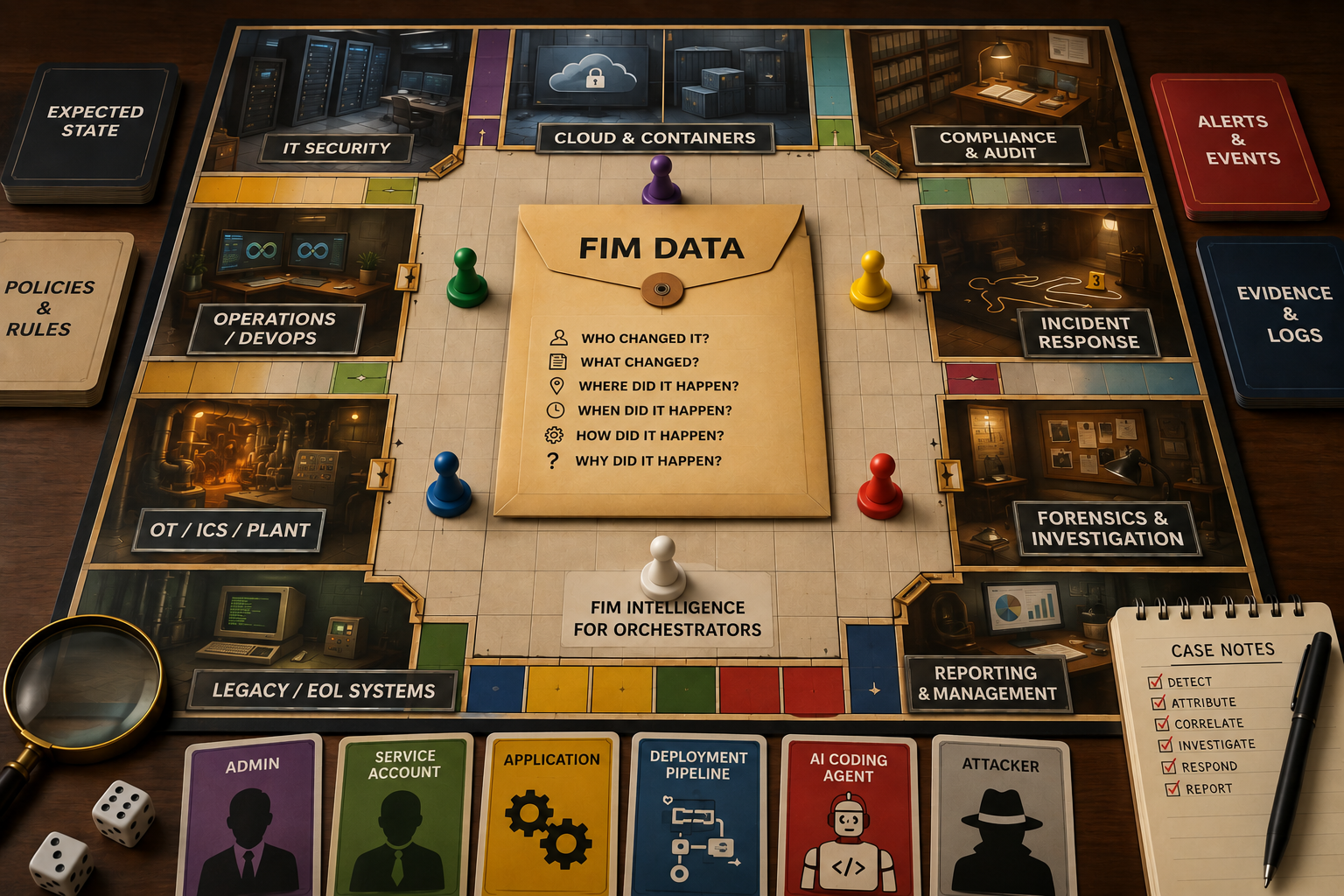
Who changed it? What changed? Where did it happen? When did it happen? How did it happen?
And ultimately: Why?
Think of it as the cybersecurity equivalent of a detective game. Discovering the change is the beginning of the investigation rather than necessarily the answer.
A modification might have been made by an administrator performing routine maintenance. But it could also originate from an application, software update, service account, automated deployment process, CI/CD pipeline, script, AI coding agent, or attacker using compromised legitimate credentials.
That’s why attribution and context matter. A change to a critical configuration file at 2:15 p.m. during scheduled maintenance can have a very different meaning from the same modification occurring unexpectedly at 2:15 a.m.
FIM doesn’t necessarily tell you why something happened. But FIM data, correlated with logs and other security information, can provide evidence that helps teams determine whether a change was authorized, accidental, suspicious, or malicious.
Learn more about file integrity monitoring (FIM).
Why Real-Time File Integrity Monitoring Makes a Difference
Knowing about an unauthorized change eventually isn’t necessarily good enough.
Traditional scheduled file integrity scans can establish whether the current state of a file differs from its previously recorded state. Real-time file integrity monitoring can detect changes as they occur, substantially reducing the period between modification and discovery.
That difference has become increasingly important as cyberattacks become faster and more automated.
Attackers may modify configuration files, scripts, binaries, registry entries, startup settings, permissions, or other system components to establish persistence, weaken security controls, escalate privileges, or prepare for additional attack stages. Automated and AI-assisted attacks can accelerate these activities further.
A change detected immediately gives defenders an opportunity to investigate while the event is still fresh and potentially before the attacker can progress further.
Real-time FIM can therefore complement other endpoint detection and response capabilities. Instead of simply establishing after an incident that something changed, security teams gain another source of continuous telemetry that can help detect suspicious activity and support faster investigation and response.
File Change Monitoring Isn’t Just for Security Teams
Cybersecurity may be an obvious application, but file change monitoring can be valuable anywhere unexpected system changes create risk.
For IT operations and DevOps teams, FIM data can help troubleshoot application failures and determine whether a deployment, administrator, automated process, software update, or configuration modification preceded a problem. An unexpected change isn’t always an attack. Sometimes somebody fixes one problem and inadvertently creates another.
In cloud and container environments, monitoring can help teams identify unexpected changes to configurations, applications, supporting infrastructure—and important workloads, i.e., the applications, services, databases, and processes a system runs. It can also provide another means of identifying deviations from an organization’s expected system state.
For legacy and end-of-life systems, file change monitoring can be particularly valuable because these systems may lack some of the security capabilities available on newer platforms. When upgrading or patching isn’t immediately possible, continuous monitoring can become an important compensating security control.
The common denominator is visibility: something changed, and somebody needs to know what happened.
FIM in OT, ICS, and Plant Environments
The consequences of an unexpected change can become even more significant in operational technology (OT) and industrial control system (ICS) environments.
Manufacturing facilities, utilities, transportation systems, energy companies, and other critical infrastructure operators rely on configurations and systems that support physical processes. Unauthorized or accidental changes to supporting servers, engineering workstations, human-machine interfaces, applications, scripts, or configuration files can create both cybersecurity and operational concerns.
File change monitoring can help organizations identify configuration drift and unexpected modifications while providing historical information about system changes.
Figure 1: File Integrity Monitoring Event Details
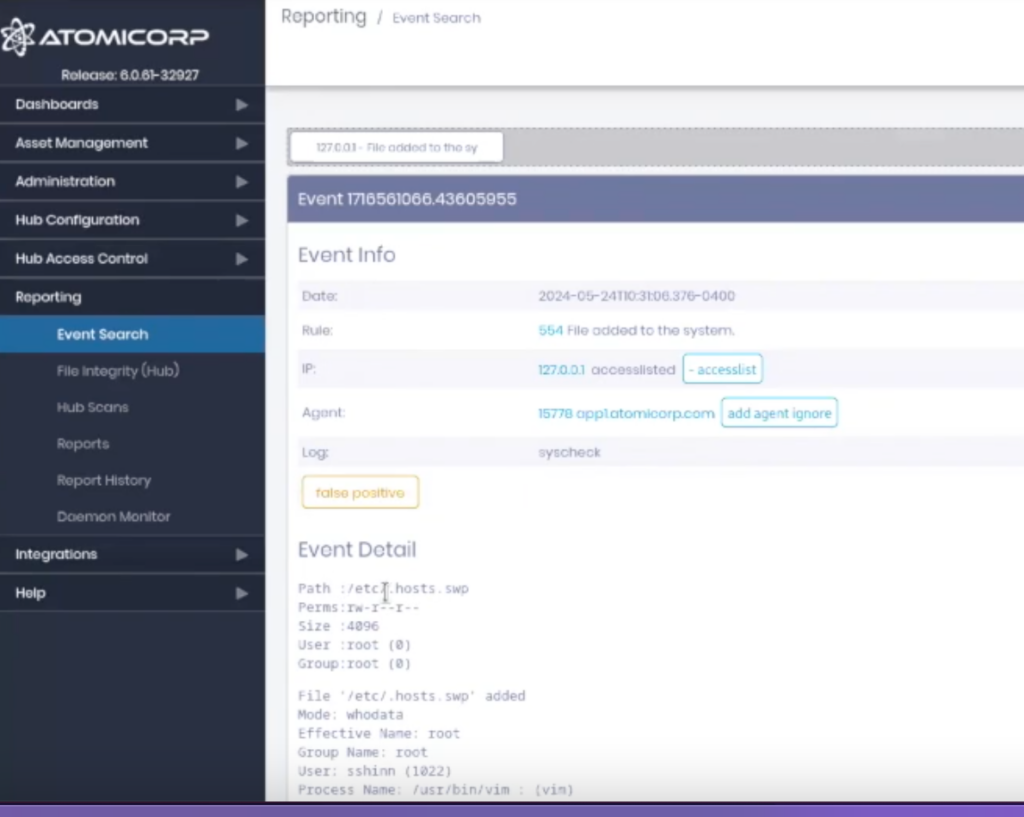
That can make FIM useful not only to security personnel but also to IT administrators, plant managers, engineers, and operations teams investigating questions such as: What changed? When? Was it authorized? And what else happened around the same time?
The objective isn’t to replace specialized OT monitoring and change-management processes. It is to add another source of system integrity and change intelligence.
File Integrity Monitoring for Compliance and Audit Readiness
FIM also retains the role for which many organizations know it best: supporting cybersecurity and compliance requirements.
File integrity, configuration management, system monitoring, audit logging, and change accountability appear across major cybersecurity standards and regulatory programs. Depending on an organization’s environment and requirements, FIM can support controls associated with PCI DSS, NIST SP 800-53 and NIST 800-171, CMMC, CIS Controls, ISO/IEC 27001, HIPAA, NERC CIP, and other compliance frameworks.
But there is an important distinction between deploying FIM to satisfy an audit requirement and using it as an ongoing security capability.
Continuous and real-time monitoring can help organizations identify configuration drift and unauthorized changes between assessments rather than discovering problems during the next scheduled audit. Historical FIM data can also provide evidence showing what changed, when changes occurred, and how systems have been monitored over time.
In that sense, compliance may establish the requirement for FIM, but security and operations determine how much value organizations get from it.
Got FIM and PCI DSS requirements?
Leave the Detective Work to Automated FIM
The challenge with monitoring modern environments isn’t simply collecting more data. Security teams already have plenty of that.
The goal is to turn file and system changes into useful information without requiring people to manually investigate every legitimate update, temporary file, application modification, or routine system event.
Advanced FIM rules and automation can help organizations monitor important files and configurations, identify meaningful changes, reduce unnecessary noise, and provide the contextual information analysts need to investigate unusual activity.
Atomicorp provides real-time file integrity monitoring as part of Atomic OSSEC, its endpoint detection and response (EDR) and continuous security monitoring platform. Atomic OSSEC combines FIM with capabilities including intrusion and malware detection, vulnerability detection, log monitoring and analysis, compliance monitoring, reporting, and automated response.
Because when an important file changes, knowing that it changed is useful.
Knowing who—or what—changed it, when it happened, where it occurred, and what happened around it can turn a simple file-change alert into actionable security intelligence.
Read more about file integrity monitoring (FIM).
FIM as a Service
Organizations that need FIM without wanting to build, configure, and manage the underlying monitoring infrastructure can also use Atomicorp’s FIM as a Service. The service provides an easier way to implement advanced file integrity monitoring while reducing the configuration and orchestration burden on internal teams. All Atomicorp products and services include expert professional support.
Learn more about Atomicorp’s monthly FIM as a Service offering.
Discuss your specific FIM requirements — Contact Us