
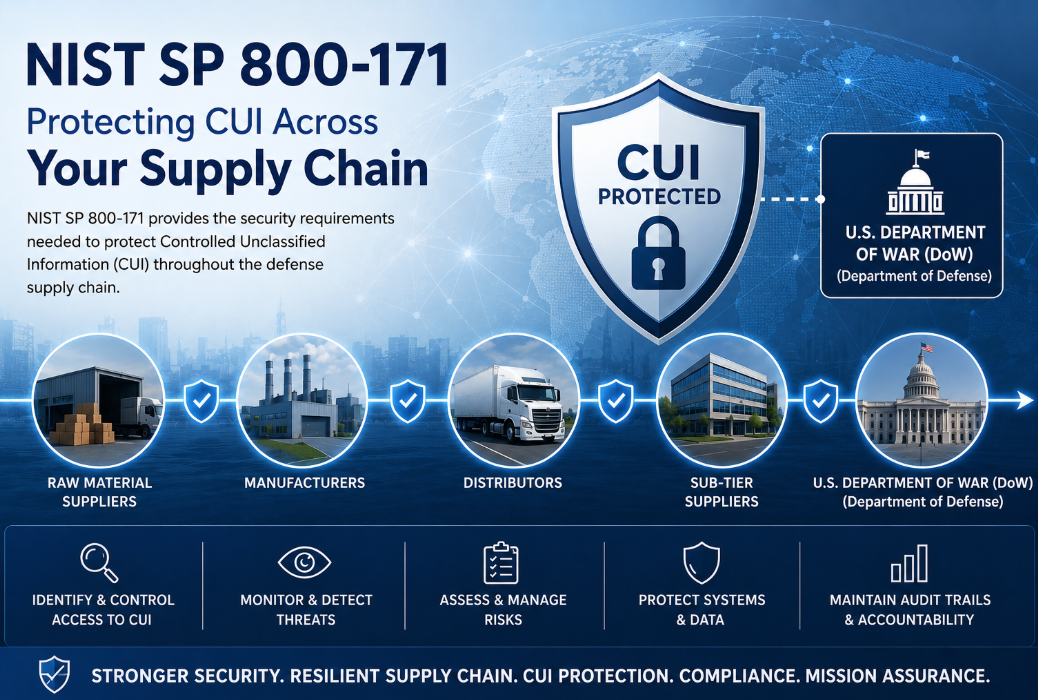
NIST SP 800-171 Rev. 3: The Current Modern CUI Baseline
For government contractors and MSPs that store, process, or transmit Controlled Unclassified Information (CUI), NIST SP 800-171 Rev. 3, published on May 14, 2024, provides a modern framework for strengthening security while preparing them for evolving federal cybersecurity requirements, including those that may be reflected in future CMMC and FedRAMP updates. Atomicorp delivers the endpoint protection, continuous monitoring, file integrity monitoring, and compliance capabilities that help organizations put these principles into practice.
NIST 800-171 Rev. 3 Still Matters Amid Changing Compliance Requirements
NIST SP 800-171 Rev. 3 is much more than a DoD compliance update. Its primary purpose is to help organizations protect Controlled Unclassified Information (CUI), but it also reinforces enduring cybersecurity principles that are becoming common expectations across agencies and prime contractors:
- Continuous monitoring and validation of controls
- Stronger identity and access enforcement
- Defense in depth and improved risk management
- Supply chain and cloud security awareness
- Operational resilience and continuous improvement
These themes give government customers a shared language for what “good” looks like, regardless of which specific program or contract clauses carry them forward.
Let Atomicorp help with your NIST 800-171 compliance and FedRAMP and CMMC readiness.
Visit our Compliance page.
The NIST Shift to Continuous Monitoring and Validation
Traditional security models revolved around periodic assessment: annual audits, quarterly scans, and scheduled penetration tests. That cadence no longer matches the speed and automation of modern threats.
- AI-accelerated attacks are shrinking the time between vulnerability disclosure and exploitation.
- New CVEs can be weaponized at scale before traditional review and approval cycles complete.
- Static controls and yearly attestation simply can’t keep pace.
Rev. 3 reflects this shift by emphasizing continuous monitoring NIST 800-171 Rev. 3-aligned practices and ongoing verification of control effectiveness. Organizations increasingly need:
- NIST 800-171 continuous monitoring that goes beyond log collection and shows how controls are behaving in real time.
- Continuous vulnerability detection and risk-driven prioritization of remediation.
- Real-time file integrity monitoring (FIM) on systems that store or process CUI.
- Endpoint detection and response (EDR) to contain and remediate threats quickly.
- Continuous compliance monitoring to map evidence directly to NIST 800-171 control requirements.
- Automated response rules where appropriate, to reduce dwell time without waiting for manual action.
The emphasis moves from “Did we meet the requirement last year?” to “Are we meeting it right now?”
Check out the continuous monitoring in Atomic OSSEC.
A Practical Foundation in an Evolving Compliance Landscape
While programs such as CMMC continue to evolve, NIST SP 800-171 Revision 3 offers organizations a modern framework for improving security and reducing risk. Implementing its core controls can strengthen cyber resilience today while helping organizations prepare for future federal cybersecurity requirements.
Continuous Monitoring and Visibility
Rev. 3 pushes organizations toward continuous visibility and, increasingly, observability:
- Telemetry from endpoints, workloads, and applications becomes expected.
- Visibility evolves into understanding system state and behavior in context.
- NIST 800-171 expectations for continuous visibility mean being able to demonstrate, at any point in time, how systems handling CUI are protected and monitored.
Risk Management and Defense in Depth
Rev. 3 reinforces risk-based decision-making and layered controls:
- Controls across identity, network, host, application, and data working together.
- Risk-based decisions that prioritize CUI and mission impact, not just checklist completion.
- Integration of vulnerability, configuration, and threat intelligence into a single picture of exposure.
Supply Chain and Cloud Awareness
Contractors and MSPs operate within complex supply chains and cloud ecosystems:
- Third-party services and SaaS platforms can become new attack surfaces for CUI.
- Rev. 3 expectations encourage clearer understanding of where CUI resides and how providers protect it.
- That includes stronger contracts, shared responsibility models, and, where possible, monitoring of third-party controls.
Operational Resilience and Continuous Improvement
Rev. 3 also emphasizes resilience:
- Planning for continuity and recovery when cyber incidents affect CUI.
- Learning from incidents, audits, and monitoring to improve policies and controls.
- Treating improvement as ongoing work, not a one-time remediation project.
Whether your organization ultimately adopts Rev. 3 through CMMC, another federal program, or specific customer requirements, these priorities seem to represent the direction government cybersecurity is moving. Aligning with them now makes your posture more adaptable as individual programs evolve.
Read the NIST 800-171 Rev. 3 standard.
The NIST 800-171 CUI Baseline
For many contractors, the NIST 800-171 CUI baseline is becoming a design requirement rather than an afterthought:
- New systems and cloud workloads are increasingly architected with Rev. 3 controls in mind.
- MSP offerings for federal customers are being updated to explicitly support NIST SP 800-171 Revision 3.
- NIST 800-171 Rev. 3 continuous monitoring capabilities are treated as core services, not optional add-ons.
This baseline-first mindset reduces rework and aligns investments with long-term expectations for CUI protection.
How Atomicorp Supports NIST 800-171 Rev. 3 Priorities
Atomicorp is built to help government contractors and MSPs achieve the kind of continuous monitoring, defense in depth, and automation Rev. 3 anticipates.
Atomicorp provides:
- Continuous security monitoring across workloads and infrastructure
- Continuous vulnerability and compliance scanning mapped to NIST 800-171 controls
- Real-time file integrity monitoring (FIM) for systems and repositories that handle CUI
- Antivirus and antimalware to protect systems inline
- SIEM capabilities for correlation, alerting, and reporting
- Active response and automated response rules to contain threats quickly
- Log audit controls for evidencing activity, configuration changes, and policy enforcement
- Additional security and compliance controls that support continuous monitoring, defense in depth, and compliance automation
For organizations aligning with NIST SP 800-171 Rev. 3, Atomicorp helps improve the continuous visibility needed to monitor systems, automate evidence collection and reporting for audits and ongoing oversight, and reduce the operational burden of maintaining a strong security posture across on-premises, hybrid, and cloud environments.
Learn more about the Atomic OSSEC EDR.