
AI-Speed Vulnerability Exploitation, and Layered Security Countermeasures
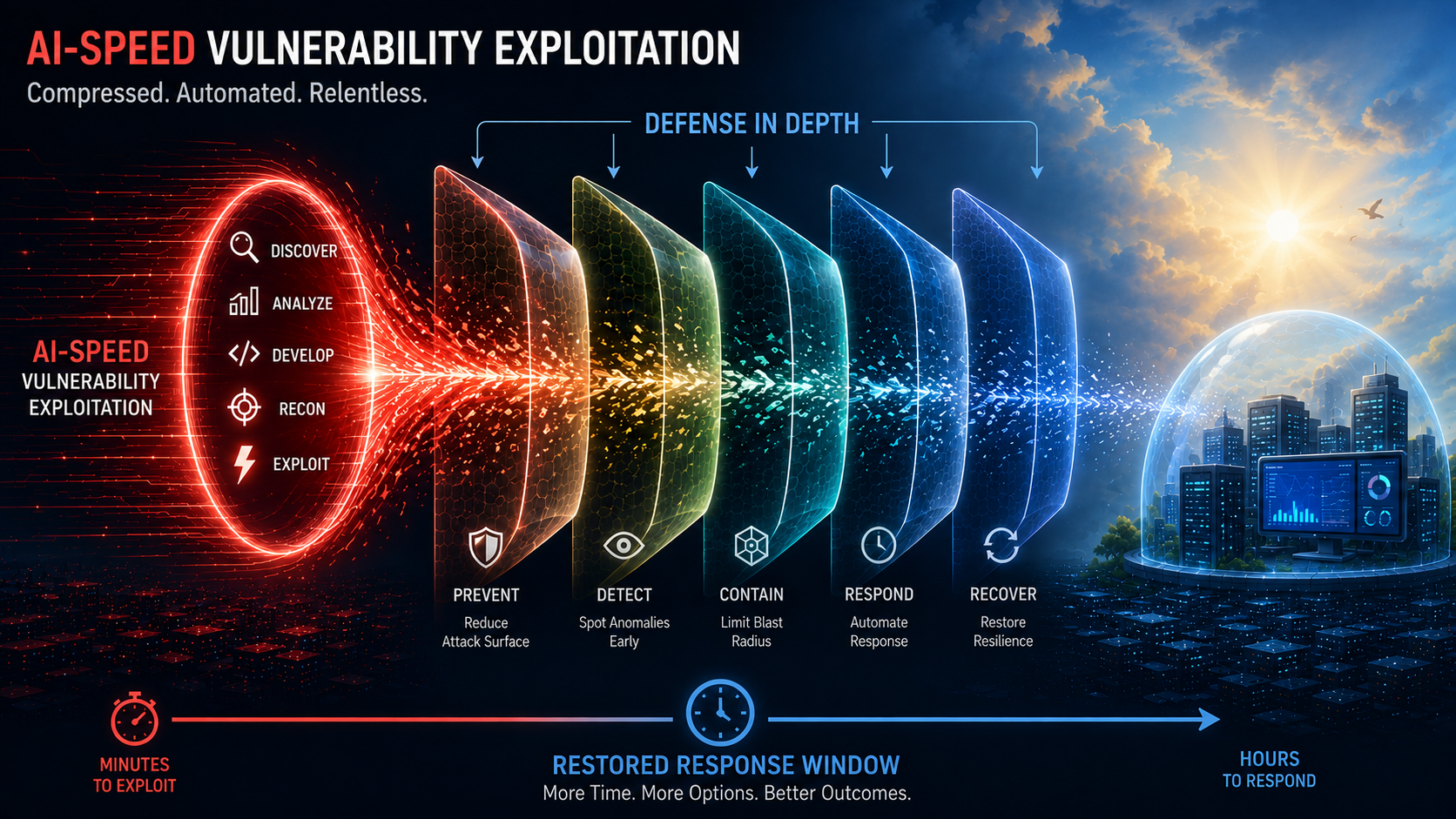
Artificial intelligence is changing more than the sophistication of cyber attacks—it is changing the speed of attacks. AI-speed vulnerability exploitation enables attackers to discover weaknesses, generate exploits, perform reconnaissance, and launch attacks in a fraction of the time previously required by human operators. As the defender’s response window shrinks, defense in depth cybersecurity becomes increasingly important for detecting attacks early, slowing attackers down, and buying valuable time for response and remediation. In addition, limiting damage through blast radius reduction should also be a security architecture principle.
AI Doesn’t Need X-Ray Vision to Find Vulnerabilities in Your Apps
Imagine someone intent on harming you possessed an extraordinary ability. They could instantly identify every weakness, every vulnerable moment, and every circumstance most likely to work in their favor. Rather than guessing, they would know exactly where to strike. AI is good at finding problems and vulnerabilities and assembling tools to attack, it isn’t making it easier to solve vulnerabilities. AI analyzes data faster and finds vulnerabilities and accelerates the entire exploitation process.
Fortunately, people cannot peer inside one another this way.
Software, however, is a different story. Although AI-speed vulnerability exploits may be exaggerated, they are a real threat.
Modern software has become too large and interconnected for any individual to fully understand. Artificial intelligence is increasingly capable of analyzing applications, dependencies, exposed services, and potential attack paths at extraordinary speed. The result is what we describe as AI-speed vulnerability exploitation, and there is a potential wave of it headed everyone’s way sooner, not later, according to a recent Five Eyes warning.
Organizations may never be able to prevent AI from becoming faster, but they can build defense in depth that forces AI-speed attacks to overcome multiple independent security controls before reaching their objectives.
Roll out affordable multilayered cloud and endpoint security.
Visit the Atomic OSSEC EDR page.
What Is AI-Speed Vulnerability Exploitation?
AI-speed vulnerability exploitation describes the emerging ability of artificial intelligence to compress the entire vulnerability exploitation lifecycle into a fraction of the time previously required by human attackers. AI-speed equals high-speed vulnerability exploitation. This compression cycle includes rapid vulnerability discovery and exploit development and reconnaissance and attack execution.
Rather than viewing each stage as an independent activity performed by specialists, AI increasingly has the potential to analyze software, correlate information, generate attack techniques, and identify the fastest path toward compromise as part of a largely automated workflow.
The significance of this shift extends beyond any single attack technique and changes the role that time has traditionally played in cybersecurity.
The Real Issue Isn’t Zero-Day Attacks. It’s Time.
Zero-day vulnerabilities command attention because no patch yet exists, but the broader challenge is time. Cybersecurity depends on organizations having enough time to identify vulnerabilities, test and deploy patches, investigate alerts, and respond before attackers succeed. Even compensating controls such as virtual patching are designed, in part, to buy defenders additional time.
AI threatens to disrupt this balance by accelerating vulnerability discovery, reconnaissance, exploit development, and targeting. The concern is therefore not simply smarter attacks, but a shrinking defender response window. Verizon itself characterizes AI as accelerating exploitation from months toward hours.
The Verizon 2026 Data Breach Investigations Report (DBIR) illustrates the growing imbalance between exploitation and remediation:
- Vulnerability exploitation accounted for 31 percent of breach entry, compared with 13 percent for credential abuse.
- Only 26 percent of critical vulnerabilities tracked through CISA KEV were fully remediated in 2025, down from 38 percent the prior year.
- Median time to full remediation increased from 32 to 43 days, while organizations faced 50 percent more critical vulnerabilities to patch at the median.
Source: Verizon, 2026 Data Breach Investigations Report (DBIR).
CISA data indicates that known vulnerability exploitation continued beyond Verizon’s October 31, 2025 reporting cutoff. Based on KEV catalog additions by date, 31 vulnerabilities were added between November 1 and December 31, 2025, followed by 181 additions from January 1 through August 17, 2026. CISA describes KEV as its authoritative source for vulnerabilities known to have been exploited in the wild; these additions indicate continued exploitation, not the number of attacks or breaches.
The resulting challenge is a convergence of more vulnerabilities, continued exploitation, and less time to respond. As attack timelines contract while remediation timelines remain measured in weeks, traditional vulnerability management processes face increasing pressure. The issue is no longer simply whether organizations can patch—it is whether they can act before the available response window closes.
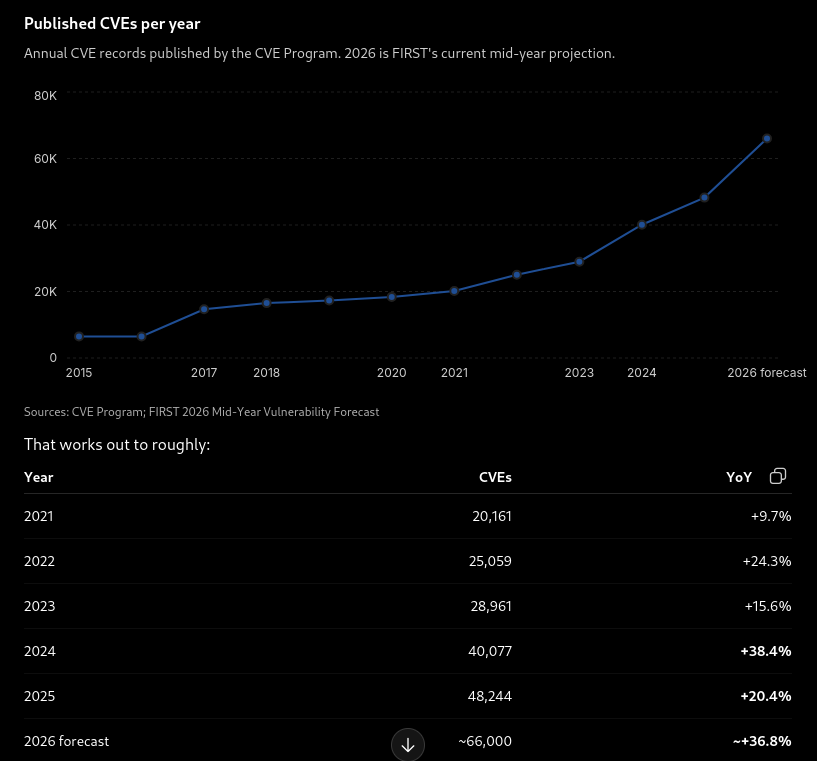
As our projections detail, the growth and frequency will continue, growing 36.8 percent year over year from 2025 to 2026.
Figure 1: 2026 CVE Forecast
Discover how you resolve and mitigate vulnerabilities and thwart faster attacks.
From Human-Speed to AI-Speed
Traditional vulnerability exploitation has generally been a sequential process. Researchers discover a vulnerability. Developers analyze it. Exploit writers create proof-of-concept code. Attackers adapt the exploit for real-world environments, identify vulnerable systems, and eventually launch attacks.
Artificial intelligence changes that workflow.
Instead of progressing through each step individually, AI can assist with multiple activities simultaneously. It can examine software inventories, analyze dependency relationships, correlate known vulnerabilities, identify exposed services, recommend attack paths, generate exploit variations, and continuously refine its approach based on new information.
Rather than simply making existing attacks faster, AI begins to assemble complete attack chains at machine speed instead of human speed.
That distinction is important. Organizations should not think of AI merely as a better exploit generator. They should recognize that AI has the potential to coordinate reconnaissance, analysis, planning, and execution into a continuous process that dramatically shortens the time between vulnerability discovery and attempted exploitation.
Defense in Depth Restores Time
If AI-speed vulnerability exploitation is fundamentally about compressing time, then defense in depth is fundamentally about restoring it.
No organization can prevent artificial intelligence from becoming faster. What organizations can do is make attacks take longer to succeed. Every independent security control that detects suspicious behavior, blocks exploitation, limits lateral movement, or automates response extends the defender’s response window. Rather than relying on a single preventive measure, defense in depth forces attackers to overcome multiple obstacles before they can reach their objective.
If AI-speed vulnerability exploitation is fundamentally about compressing time, then defense in depth is fundamentally about restoring it.
A defense in depth solution should have:
- Endpoint detection and response (EDR) to continuously monitor systems for suspicious behavior, privilege escalation, malware execution, lateral movement, and persistence techniques.
- File integrity monitoring (FIM) to immediately identify unauthorized changes that may indicate compromise.
- Automated response and security orchestration (SOAR) to reduce manual investigation time by rapidly isolating affected systems, updating security policies, or initiating predefined response workflows.
- Virtual patching through a web application firewall (WAF) to help block exploitation attempts targeting vulnerable Internet-facing applications while permanent software updates are being tested and deployed.
- Cloud workload protection to extend visibility into virtual machines, containers, and cloud-native workloads where AI-speed attacks may rapidly spread across distributed environments.
Individually, each technology contributes meaningful protection.
Together, they accomplish something even more valuable: they restore time. Every security layer that detects, delays, blocks, or contains an attacker increases the opportunity for defenders to investigate, respond, and prevent compromise before significant damage occurs.
Reducing the Blast Radius
Defenders can also limit the damage attackers can cause after gaining a foothold. Restrict access and lateral movement through segmentation and least privilege; reduce the attack surface with application controls and web application firewalls; and use post-exploitation and deception techniques to contain attacks before they spread.
Contact Us to find out how.
Fighting AI-Speed With Layered Security
Artificial intelligence will almost certainly continue improving vulnerability research, exploit generation, and attack automation.
Defenders need to respond against these AI-accelerated adversaries. Machine learning, behavioral analytics, automated response, and human-governed AI-assisted security operations are becoming increasingly important for identifying suspicious activity and responding faster than manual processes alone.
Ultimately, organizations should not measure success by whether they can completely stop AI from evolving. They should measure success by whether AI-speed vulnerability exploitation can successfully navigate every defensive layer protecting their environment.
Atomicorp helps organizations prepare for this emerging threat through a layered cybersecurity architecture that combines continuous vulnerability detection, endpoint detection and response, file integrity monitoring, virtual patching, cloud workload protection, web application firewalls, automated response, centralized SIEM visibility, and human-governed AI-assisted security operations. Supporting modern, legacy, cloud, and operational technology environments alike, this defense-in-depth approach helps reduce the attack surface, limit the blast radius of successful compromises, and preserve one of cybersecurity’s most valuable resources: time.